

The Serengeti is not a place you see so much as a place you measure. Nearly 15,000 square kilometres of grassland, woodland and rocky kopjes in northern Tanzania, and across it, at any moment, something like 1.3 million wildebeest, several hundred thousand zebra and gazelle, and the predators that follow them. A vehicle shows you a slice of that. A balloon shows you the pattern: the long files of animals stretched across the plain like ink lines, the rivers they must cross, the way the whole herd leans toward the rain. We have found no better way to understand the Great Migration than from a wicker basket a hundred metres up, an hour after dawn.
Where the balloons launch
Serengeti balloon flights operate from three areas, chosen to keep pace with the herds through the year. The oldest and busiest launch site is near Seronera, in the centre of the park, where the plains meet acacia woodland along the Seronera River. Resident wildlife here is dense all year round, so even outside the migration months a Seronera flight will show you giraffe, elephant, buffalo, hippo pools and, with luck, lion on a kopje. The second area is the western corridor along the Grumeti River, used in the early dry season when the herds push north-west. The third is the far north around the Mara River, for the crossing season. Which site you fly from depends on your lodge and the month, so plan the lodge around the flight.
Whichever site you use, the routine is the same. A vehicle collects you from camp around 4:30 or 5:00, well before light, and drives to the launch field. Baskets in the Serengeti are large, usually 12 to 16 passengers in compartments, and they are laid on their side for boarding, so you climb in lying on your back and the balloon rights itself during inflation. Take-off is at first light, about 6:15 to 6:30.
The migration calendar
The herds move in a rough clockwise loop and the balloon programme follows them. From December to March the wildebeest are on the short-grass plains of the south and the Ndutu area, and February is calving month, when up to half a million calves are born in a few weeks and predators are everywhere. April and May are the long rains, when the columns begin to move north-west toward the centre and the western corridor; flights continue but cancellations for weather are more frequent. June and July bring the herds to the Grumeti River, where crocodiles wait at the crossings. From late July to October the action is in the north, with the Mara River crossings that appear in every documentary. In November the short rains start and the animals turn south again to begin the cycle.
For a balloon specifically, we would pick either February in the south, for the density of animals and the calving, or August and September in the north, for the crossings. Seronera in the dry months of June to October is the safe all-rounder, with reliable weather and plenty to see even if the main herd is elsewhere.
What you see from the basket
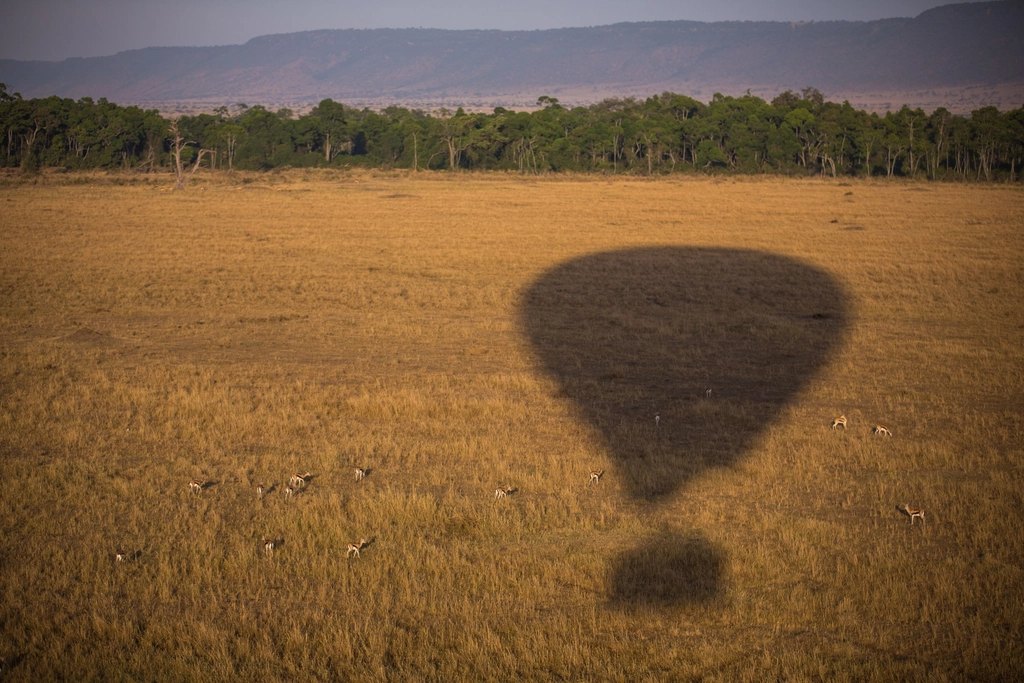
A Serengeti flight lasts about an hour, and the pilot spends most of it low, often below 100 metres, sometimes at treetop height along a river line. From this height the animals do not scatter the way they do from a vehicle; they look up, and go on grazing. We have drifted over a herd of several thousand wildebeest packed so tightly that the ground seemed to move, watched a pride of lion sprawled on a granite kopje, and followed a hyena trotting home along a game trail with the shadow of the balloon a few metres behind it. Hippos in the river channels, elephant in the woodland, giraffe browsing the tops of acacias, and long-legged secretary birds pacing the grass are all common. Cheetah and leopard need luck. Every few minutes the pilot climbs to 300 or 500 metres to reset the view, and from there the plain runs to a horizon that curves. Then the basket comes down again and the grass rushes past.
Landings are on open ground wherever the wind has taken you, with the ground crew waiting in vehicles.
The bush breakfast
The Serengeti gave the ballooning world one of its most civilised traditions. After landing, guests are driven a short distance to a table laid under an acacia, with white linen, proper cutlery and a cooked breakfast served by staff who have been up since three. A glass of sparkling wine is poured as a toast, a nod to the old French custom of calming farmers with champagne after landing in their fields. Eating eggs in the open with zebra grazing nearby is, we admit, a large part of why people book. Allow until around 9:30 before you are back in a vehicle and heading to camp or on to a game drive.
Prices, packing and getting there
This is one of the most expensive balloon flights anywhere. Expect around 550 to 650 US dollars per person, sometimes more in peak crossing months, with the breakfast, transfers from nearby lodges and a certificate included. Children under a certain age and height, usually seven years and about 1.2 metres, are not carried.
- Layers: the plain sits at 1,500 to 1,800 metres and the pre-dawn air can be close to 10 degrees C, but it is warm by nine.
- Closed shoes and long trousers for the landing and the walk to breakfast.
- A hat, sunscreen and a bandana for the dust in the dry season.
- Binoculars and a zoom lens; the balloon gets close, but not that close.
Almost everyone reaches the Serengeti through Arusha, which is served by Kilimanjaro International Airport about 50 kilometres away. From Arusha, light aircraft fly to Seronera and the other park airstrips in about an hour, or you can drive: roughly eight hours via the Ngorongoro crater rim, dusty but magnificent, and usually done as part of a longer safari. Park fees are paid separately and are substantial. Book the flight at the same time as the lodge, because baskets in July and August fill months ahead.
Our verdict
If you only ever take one balloon flight, it is hard to argue against this one. The combination of scale, wildlife, silence and a breakfast under a tree is unlike anything else in the sport. Go in the right month for the herds, stay near the launch site, and accept that the alarm will ring at four. You will not mind.
