
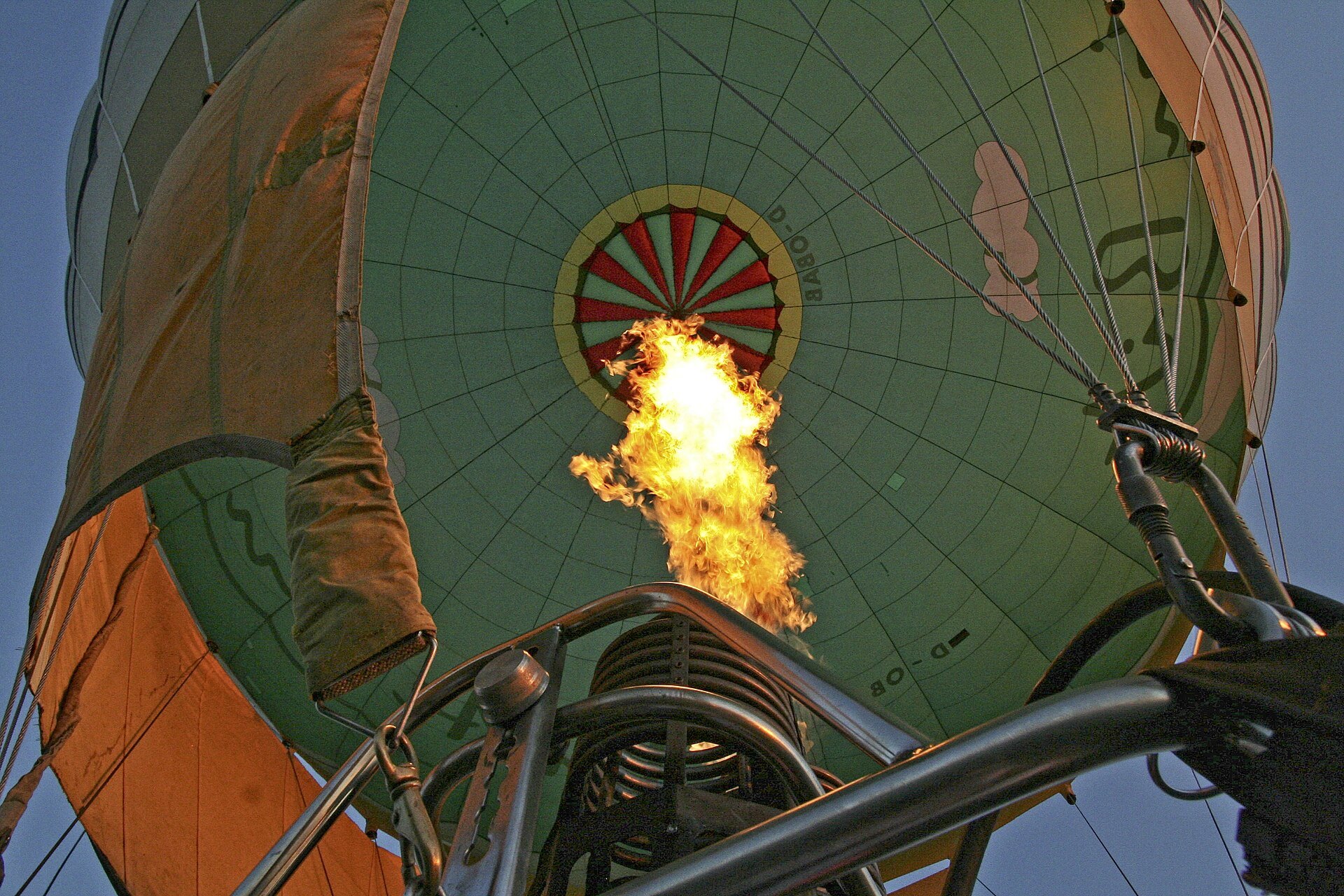

Every hot air balloon flying today traces its family tree back to a cold field near Bruning, Nebraska, on the morning of October 22, 1960. That is where Ed Yost lifted off in a balloon that carried its own propane heat source and, for the first time, stayed up long enough to be called a flight rather than a hop. The 1783 balloons of France had produced a beautiful idea that was almost immediately abandoned in favour of gas. Yost’s contribution was to make hot air practical, and then to spend four decades quietly proving it.
An engineer of the plastic balloon era
Paul Edward Yost was born on June 30, 1919, on a farm near Bristow, Iowa. He trained as an aircraft mechanic and pilot, and after the war he joined the aeronautical research division of General Mills in Minneapolis. The company, better known for breakfast cereal, was then the leading builder of high-altitude polyethylene balloons for the US Navy and for scientific payloads. Yost spent the early 1950s launching and recovering these enormous plastic gas balloons, and learned envelope materials from the inside.
In 1956 he and a handful of colleagues left to found Raven Industries in Sioux Falls, South Dakota. The Office of Naval Research wanted a reusable balloon that could be inflated in the field without a supply of expensive lifting gas. Hot air, dismissed as a novelty for a century and a half, was the obvious candidate if someone could solve the problem that had always defeated it: keeping the air hot once the balloon was airborne.
The burner, the fabric and the vent
Yost’s answer combined three ideas that now seem obvious, which is usually the sign of a good invention. The first was the burner. Earlier hot air balloons had carried straw, wool or a primitive stove; Yost used bottled liquid propane vaporised through coils and burned in a jet aimed up into the mouth of the envelope. Propane is cheap, easy to control and gives a very hot flame from a small, light apparatus. By 1955 he had made tethered tests with an improvised set-up, and by 1960 the burner was reliable enough to trust with a free flight.
The second idea was the envelope: a lightweight woven nylon, coated to reduce porosity and cut into panels and gores in the manner of a parachute. Rip-stop nylon, in which a heavier reinforcing thread is woven through the fabric at intervals, meant that a small tear would stay small. The third idea was a way of getting the hot air out again on demand. Yost built a rip panel into the top of the envelope, a sealed section the pilot could tear open on landing to deflate the balloon quickly and stop it dragging across the ground. Later designs refined this into the parachute vent most balloons use today, but the principle was his.
Bruning, Nebraska, October 1960
The balloon that flew at Bruning was about 40 feet in diameter, tiny by modern standards, with a plywood seat rather than a wicker basket and the propane tanks strapped beside the pilot. Yost lifted off, climbed, and stayed aloft for an hour and 35 minutes, covering about three miles before landing in a field. It was not a dramatic flight. What mattered was that a man had gone up under hot air, controlled his altitude with a burner, and come back down when and roughly where he chose.
The Navy contract ran out soon afterwards, but Raven saw the possibility of a sport. The company’s first commercial hot air balloon, the Vulcoon, went on sale in the early 1960s. It was rough and leaked heat, but it worked, and the pilots who bought them formed the first generation of a new activity. Yost designed most of Raven’s early balloons and trained many of the people who went on to teach everyone else.
Across the Channel with Don Piccard
On April 13, 1963, Yost and Don Piccard, son of the stratospheric balloonist Jean Piccard, flew a Raven balloon named Channel Champ from Rye, on the English coast, across the English Channel to a landing in northern France. The crossing took a little over three hours. It was the first crossing of the Channel by hot air balloon, and it did more than any advertisement could to persuade Europeans that the new American machines were serious aircraft.
Yost left Raven in the 1970s and continued to design balloons on his own account, and he had never lost his affection for the gas balloons of his General Mills years.
The Silver Fox and the Atlantic
In October 1976 Yost set out to do alone what no one had yet managed with any crew: cross the Atlantic by balloon. His helium balloon, the Silver Fox, lifted off from Milbridge, Maine, on October 5 with Yost in a small boat-shaped gondola of his own design. He flew east for four and a half days before the winds turned against him. On October 10, some 700 miles short of the Portuguese coast, he ditched in the sea near the Azores and was picked up by a passing ship.
The attempt failed, but the numbers it produced did not. Yost had flown 2,475 miles and stayed aloft for 107 hours and 37 minutes, both world records for gas balloons at the time. He had also shown the crossing was possible. In August 1978 Ben Abruzzo, Maxie Anderson and Larry Newman completed the first Atlantic crossing in Double Eagle II. The balloon and its gondola were built by Ed Yost. In 1981 he also built Double Eagle V, which made the first balloon crossing of the Pacific.
A long and modest afterlife
Yost’s later years were spent in northern New Mexico, near Taos, in the kind of high dry country that balloonists love. He received the major honours the sport can give, including recognition from the Federation Aeronautique Internationale and induction into the halls of fame of both gas and hot air ballooning, and he remained a working builder and consultant well into old age. He died at home in Vadito, New Mexico, on May 27, 2007, at the age of 87.
We like to remember him not as the father of anything, but as a careful engineer who looked at an idea everyone had given up on and saw that the missing piece was simply a better stove. The next time you hear a burner roar at dawn, that is the sound of Bruning, Nebraska, in October 1960.
