
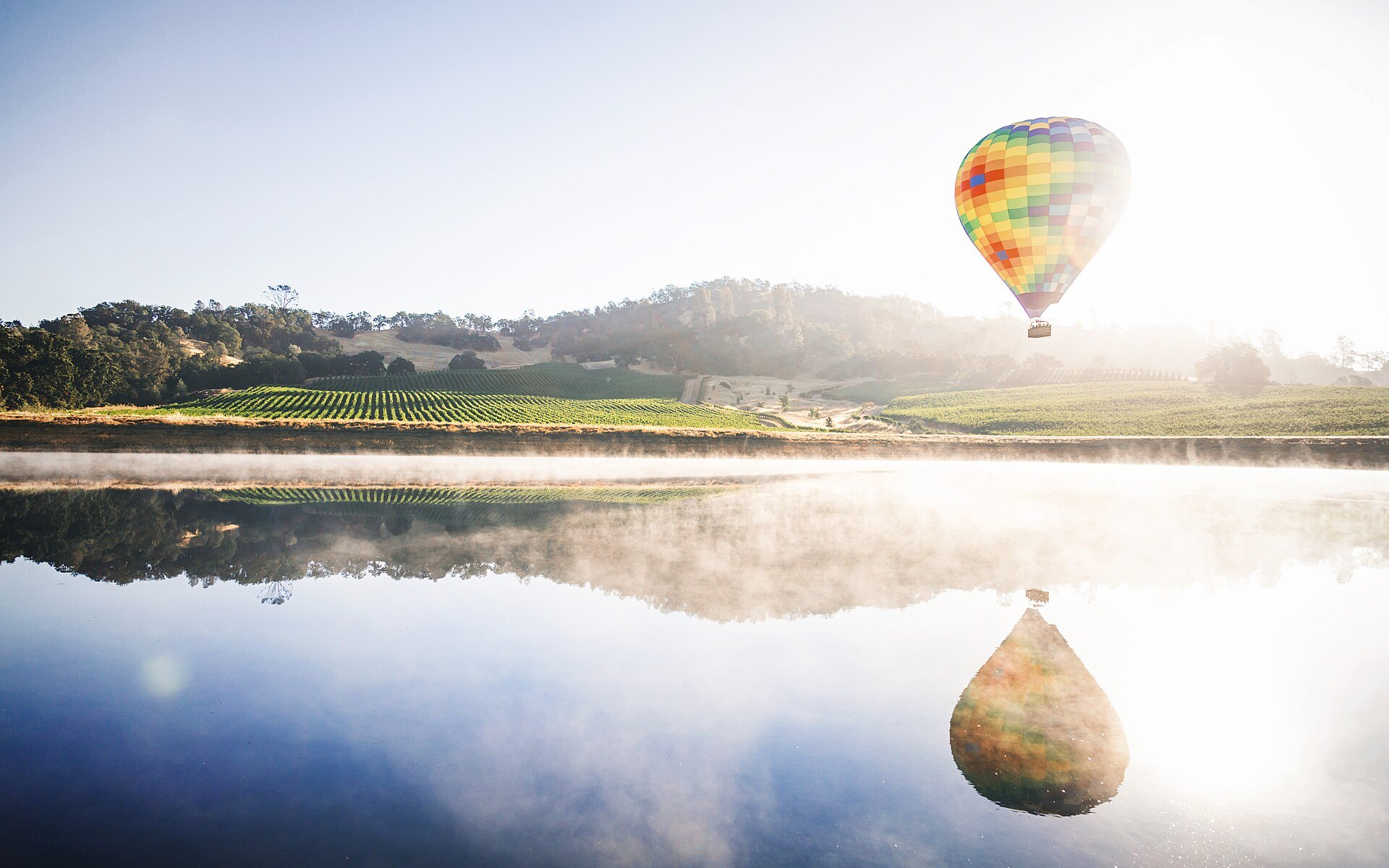

A balloon basket is one of the best photographic platforms we know. It is silent, it is stable, it moves slowly and it places you a few hundred meters above the landscape at the exact hour when the light is at its softest. It is also cramped, shared with strangers, and hanging under an open flame. Getting good pictures from it is less about gear than about preparation and a little courtesy.
Choose your lens before you leave the house
You will not be changing lenses in the basket. There is no room to put a bag down, your hands will be cold, and a dropped rear cap is gone forever. So decide on the ground what kind of pictures you want and take one body with one lens, or two bodies if you are serious.
A wide-angle lens, anywhere from 16 to 35 mm on a full-frame camera, is the natural choice for the classic shots: the burner flame filling the top of the envelope, the crew below, the curve of the horizon, and the basket rim with your fellow passengers in the foreground.
A short telephoto, 70 to 200 mm, is the lens for other balloons. At launch sites with many balloons, such as the big valleys in central Turkey or the autumn festivals in the American Southwest, the strongest images are often compressed stacks of envelopes against a ridge or a rising sun, and you cannot get those with a wide lens. If you can only bring one lens, a 24-105 or 24-120 zoom is the sensible compromise.
Whatever you take, leave the lens hood on. It protects the front element from the basket rim and from stray fingers, and it helps with flare when the sun is low.
Settings that work at sunrise
The light at launch changes fast. In the twenty minutes around sunrise you can go from needing ISO 3200 to needing ISO 100, so set the camera to auto ISO with a sensible ceiling and let it work. Shutter priority at 1/500 second or faster keeps everything crisp even when you are leaning out and the basket is swaying slightly during a burn. An aperture of f/5.6 to f/8 gives you plenty of depth from a few hundred meters up.
The two exposure problems are the same every morning. The first is shooting into the sun, which will fool any meter into underexposing the landscape. Dial in a stop or so of positive exposure compensation, or expose for the shadows and accept a bright sky. The second is the burner. A burn is far brighter than the scene around it, and if you meter on the flame your envelope will be a black hole. Meter on the fabric of the envelope, not the flame, and shoot in bursts because the flame shape changes every fraction of a second.
Shoot raw if your camera allows it. Sunrise colours and the deep orange of a lit envelope are exactly the kind of tones that clip in JPEG.
Phone tips that actually help
Most passengers shoot with a phone, and modern phones do very well here. A few things make a real difference. Wipe the lens before launch, because pockets and dew leave a smear that turns every sunrise into a haze. Tap to set focus and exposure on the landscape, not the sky, and drag the exposure slider down slightly to save the highlights. Use the ultra-wide camera for the envelope above you and the main camera for everything else; the telephoto module on most phones is fine in good light but noisy at dawn.
Turn off the flash. It does nothing at this distance and it annoys everyone in the basket. And put the phone on a wrist strap or a lanyard. We have watched a phone fall from a basket, and the pilot cannot go back for it.
Strap everything, and we mean everything
The basket rim is padded and chest-high, and the temptation to rest a camera on it is enormous. Do not. A neck strap or a cross-body strap is not optional, and the same goes for sunglasses, hats and phones. A dropped object from 300 meters is dangerous to people and animals below and can damage property. Pilots take this seriously, and many briefings state that anything unsecured stays in the vehicle.
Leave the tripod and the monopod at home. There is no room, no stable floor and no need, because the exposure times are short. A small bag that clips to your belt is enough for spare batteries and a lens cloth. Bring more batteries than you think you need; cold mornings drain them quickly.
Etiquette in a shared basket
A commercial basket carries anywhere from four to twenty people, and everyone wants the same view. The rule that works is simple: shoot from your own spot, and rotate. Most pilots turn the balloon slowly during the flight precisely so that every side of the basket gets the sunrise, the other balloons and the landscape in turn. Elbowing across the partition wins you neither friends nor better pictures.
The pilot’s compartment is off limits. The pilot needs clear access to the burner controls, the vent line and the fuel valves, and needs to see the ground during launch and landing. Do not lean into that space for a better angle, and do not ask the pilot to hold your camera.
Ask before you photograph other passengers close up. Most people are delighted, but a quick word makes it comfortable. Photographing other balloons is fair game and they will be photographing you.
Finally, drones. It is illegal in almost every jurisdiction to fly a drone from or near a manned aircraft, and a drone near a launch field is a genuine hazard to balloons on approach. Leave it at the hotel.
The shots most people forget
Everyone photographs the sunrise and the other balloons. The pictures we treasure are the quieter ones.
- The inflation, from inside the envelope if the crew allows it, when the fabric glows like a cathedral
- The crew’s faces lit by the burner in the last blue minutes before launch
- Your own shadow, with the balloon around it, sliding across a field
- The landing, from the ground, once you are out and the pilot vents the envelope
- The pack-up, with the envelope stretched across a field and the crew rolling it in
Put the camera down for a few minutes, too. The best part of a balloon flight is the silence between burns, and no picture has ever captured that.
