
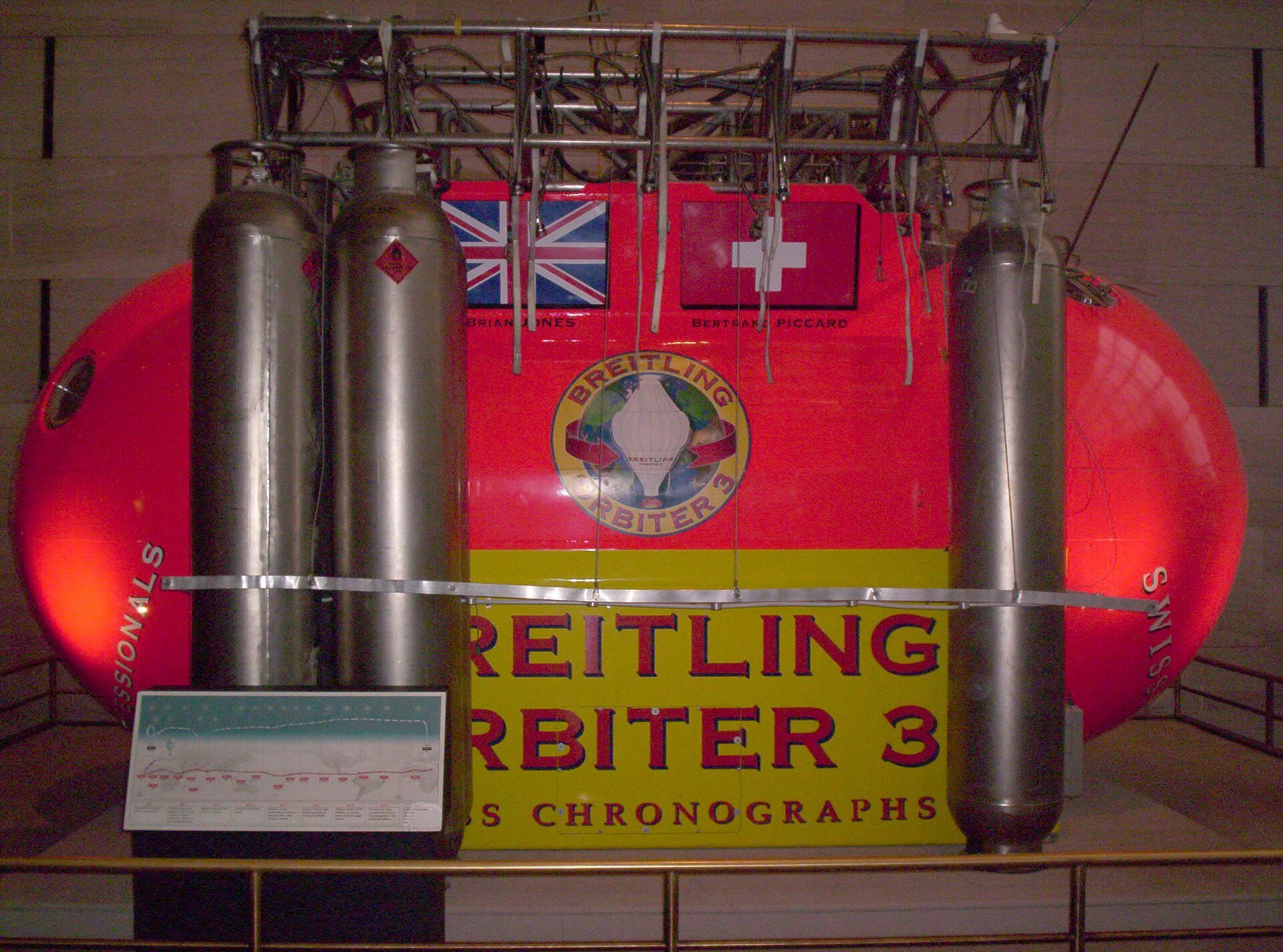

For most of the twentieth century a balloon flight around the world belonged to fiction. Jules Verne had imagined something like it in 1873, but a real balloon would have to stay aloft for weeks, cross three oceans, survive temperatures far below freezing at altitudes where the air is too thin to breathe, and do all this while unable to steer. It took until March 1999, and a decade of expensive failures, for two men in a pressurised capsule to close the loop.
The stepping stones
The oceans came first. In August 1978 Double Eagle II carried Ben Abruzzo, Maxie Anderson and Larry Newman from Maine to a field in Normandy in just under six days, the first balloon crossing of the Atlantic. In November 1981 Double Eagle V flew from Japan to California, the first crossing of the Pacific. Joe Kittinger crossed the Atlantic alone in 1984. Hot air, rather than gas, made the Atlantic in 1987 and the Pacific in 1991, in enormous envelopes flown by Richard Branson and Per Lindstrand. Each flight taught something about riding the jet stream and keeping a crew alive at altitude.
By the early 1990s the round-the-world flight was openly discussed as the last great prize, and a brewery put up a million-dollar purse for the first crew to claim it. Between 1997 and 1999 at least a dozen attempts were launched by teams from the United States, Britain, Switzerland and Australia. Several were spectacular failures.
The Rozier balloon
The winning design was a very old idea. In 1785 Jean-Francois Pilatre de Rozier had tried to cross the English Channel in a balloon combining a hydrogen cell with a hot air section beneath it, and had died in the attempt when the two met. Two centuries later the concept was revived with helium instead of hydrogen and became the standard for long-distance flight, known as the Rozier, or Roziere, balloon. The helium cell provides the lift; the hot air cone below it, heated by propane or kerosene burners, warms the helium at night when it would otherwise contract and force the balloon down. The pilot uses only a fraction of the fuel a pure hot air balloon would burn, and does not have to throw away ballast every night as a pure gas balloon must. Endurance measured in weeks became possible.
The jet streams
The other half of the equation is the weather. Jet streams are narrow rivers of fast-moving air at roughly 30,000 to 40,000 feet, flowing generally west to east around the planet, and a balloon that can reach them can be carried at 100 knots or more, several times the speed available lower down. But jet streams wander, split and stall, and a balloon that leaves one may spend days crawling across an ocean. Every serious attempt of the 1990s had a team of meteorologists on the ground, tracking the streams and calling the crew with altitude changes, sometimes several times a day. Politics mattered too. Several flights were shortened or diverted because governments, notably China and at times Russia, would not grant passage through their airspace at the moment the weather demanded it.
Three tries from Switzerland
Bertrand Piccard, a Swiss psychiatrist and grandson of the stratospheric balloonist Auguste Piccard, made his first attempt in January 1997. Breitling Orbiter, built by Cameron Balloons in Bristol, lasted six hours before a kerosene leak in the capsule forced it into the Mediterranean. The following year Breitling Orbiter 2 stayed up for nine days and 17 hours, then the longest balloon flight ever made, but was held up waiting for Chinese clearance and finally landed in Burma, far short of the goal.
The third attempt began on March 1, 1999, at 9:05 in the morning, when Breitling Orbiter 3 lifted off from the Alpine village of Chateau-d’Oex with Piccard and the British pilot Brian Jones aboard. The balloon stood 55 metres tall, with a helium cell topped by a tent of insulating fabric and a hot air cone heated by propane burners. The capsule below it was a pressurised tube about five metres long, with a bunk, a small galley, a toilet and enough room for one man to sleep while the other flew.
Nineteen days
Orbiter 3 flew south over the Mediterranean and North Africa, then turned east across the Arabian peninsula, India and southern China, staying within a narrow corridor of latitude that Chinese authorities had agreed to. Across the Pacific the balloon lost its jet stream and drifted slowly for days, dropping to speeds of a few dozen knots, before a new stream caught it and carried it at more than 100 knots towards Mexico. Fuel became the worry: the burners had been using more propane than planned, and by the Atlantic the crew were calculating hours of flight against kilograms of gas.
They crossed the finish line, the ninth meridian west over Mauritania, on March 20, 1999, and continued on to land in the Egyptian desert near the Dakhla oasis on the morning of March 21. The flight had lasted 19 days, 21 hours and 47 minutes and covered 45,755 kilometres, or 40,814 kilometres by the official great-circle calculation, at altitudes reaching about 11,750 metres. Piccard and Jones took the prize, gave half of it to a charitable foundation, and later placed the capsule in the National Air and Space Museum in Washington.
Alone around the world
The next barrier was to do it solo, and the man who had pursued it hardest was the American Steve Fossett, whose earlier attempts included a crash into the Coral Sea in August 1998 after a thunderstorm tore his balloon at 29,000 feet. On June 19, 2002, on his sixth try, he launched from Northam in Western Australia in the Spirit of Freedom, an unpressurised Rozier in which he breathed oxygen and slept in short naps. He completed the circuit on July 2 after 13 days, 8 hours and 33 minutes, and landed in Queensland two days later.
In July 2016 the Russian adventurer Fedor Konyukhov, then 64, took off from the same field at Northam in a Cameron-built Rozier and went round in 11 days, 4 hours and 20 minutes, landing near Bonnie Rock in Western Australia on July 23. His remains the fastest circumnavigation by balloon. It is a measure of how far the craft has come that a flight which was impossible for two centuries has now been made three times, and the last of them by a single pilot in less than 12 days.
