
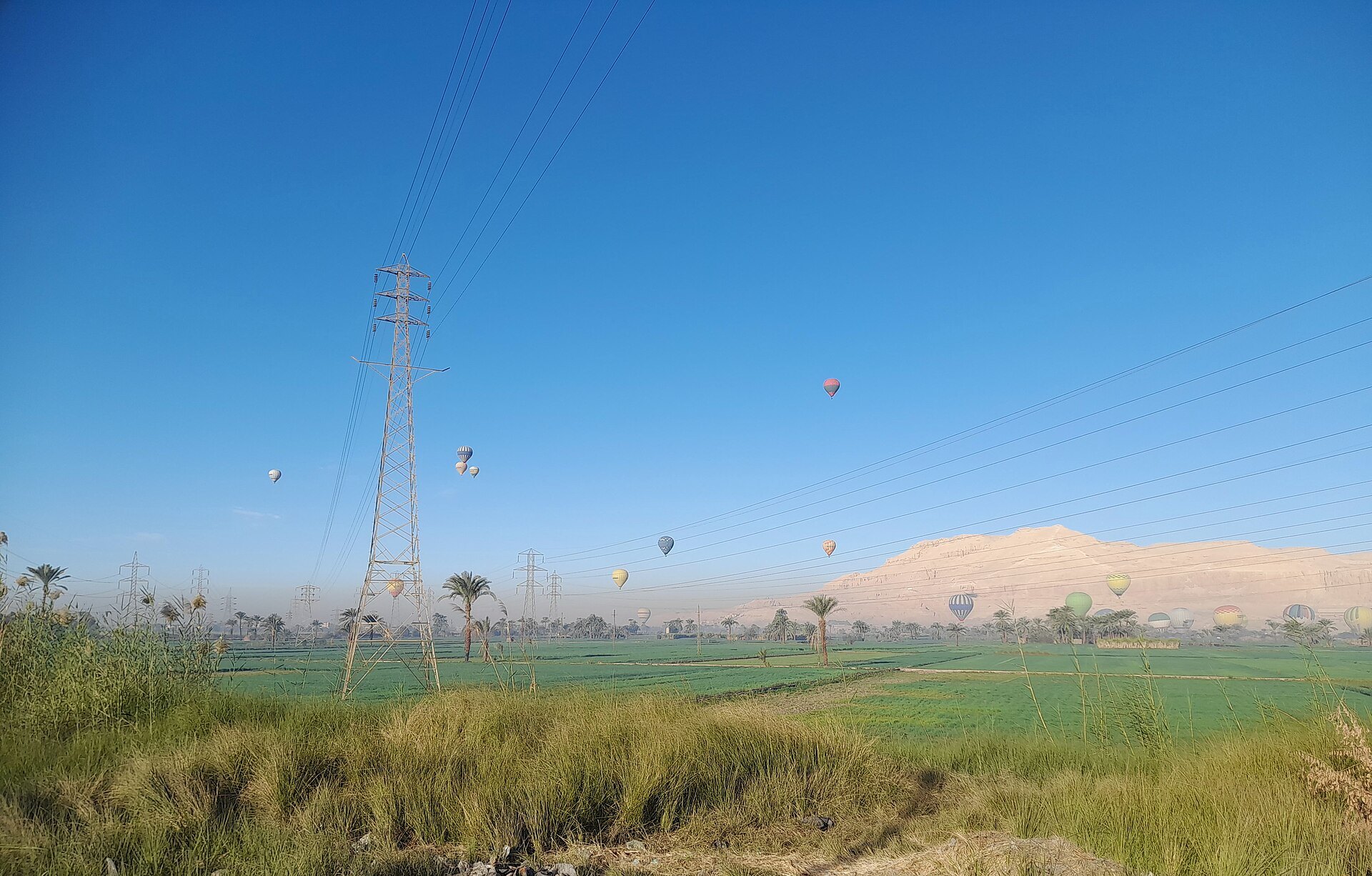

The ancient Egyptians built their cities of the living on the east bank of the Nile, where the sun rises, and their cities of the dead on the west bank, where it sets. Nowhere is that arrangement clearer than at Luxor, the site of ancient Thebes, and nowhere is it easier to see than from a balloon. Flights launch on the west bank in the last dark minutes before dawn, climb over the mortuary temples and the desert cliffs that hide the Valley of the Kings, and turn toward the river just as the sun comes up behind the columns of Karnak on the far shore. It is one of the cheapest balloon flights in the world and, for the sheer density of history under the basket, one of the richest.
What lies below: the west bank
The launch fields sit on the strip of irrigated farmland between the Nile and the desert escarpment, a few kilometres from the ferry landing. The balloon rises over sugar cane and palms, and almost immediately the monuments begin. Closest to the river stand the Colossi of Memnon, two seated statues 18 metres high that are all that remains of the temple of Amenhotep III. Beyond them, against the cliffs of Deir el-Bahari, is the temple of Hatshepsut, the queen who ruled as pharaoh in the 15th century BC, a building of three terraces and colonnades that looks startlingly modern from the air. To the south lie the Ramesseum and the vast enclosure of Medinet Habu, the temple of Ramesses III, whose painted walls still hold their colour.
The Valley of the Kings itself lies behind the escarpment, in a dry side valley beneath a pyramid-shaped peak called al-Qurn. Balloons do not normally fly directly over the tombs, but from 300 or 400 metres up you see the entrance to the valley, the ridge that separates it from Hatshepsut’s temple, and the whole logic of the place: a landscape chosen for its hidden folds and its natural pyramid. Below the cliffs, the village of Qurna and the tombs of the nobles spread over the hillside in a honeycomb of doorways.
Karnak and the east bank in the first light
The turn toward the river is the moment the flight is built around. As the sun clears the eastern hills, the Nile turns from grey to gold and the east bank appears in silhouette: the pylons and obelisks of Karnak, the largest temple complex ever built, covering more than 100 hectares, and further south the smaller temple of Luxor, once joined to it by an avenue of sphinxes nearly three kilometres long. On a still morning the balloon drifts toward the water and the pilot may take you over the river itself before landing. On windier days the flight stays over the west bank fields, which is no hardship: the light on the cliffs is the best of the day.
The flight, the season and the prices
Pick-up from east bank hotels is around 4:30 to 5:00, followed by a motorboat crossing of the Nile in the dark and a minibus to the launch field. Baskets at Luxor are large, often 16 to 28 passengers in compartments. Take-off is timed for the first light, and the flight lasts about 45 minutes, occasionally an hour, with altitudes from a few dozen metres over the farmland to 500 metres or so for the panorama. Landing is on a field or a patch of desert on the west bank, followed by a drive back to the ferry.
Flights run all year, but the season we recommend is October to April, when mornings are cool, often 10 to 15 degrees C at launch, and the air is clear. Summer flights still operate, launching earlier, but the heat by mid-morning is fierce and the haze thickens. December and January are the busiest weeks and sell out.
Luxor is remarkably affordable. Prices for a shared flight range from about 50 to 150 US dollars per person, or 45 to 140 euros, depending on how and where you book, the size of the basket and the time of year. The lowest prices are usually found in Luxor itself the day before; the highest come bundled into cruise packages. Paying a little more for a smaller basket and a longer flight is, in our experience, worth it.
Safety, addressed plainly
Readers will know that Luxor’s balloon industry has a history that needs mentioning. In February 2013 a balloon caught fire on landing and crashed, killing 19 passengers, the deadliest accident in the sport’s history. A further fatal accident in January 2018 killed one passenger. Both led to suspensions of flying and to changes by the Egyptian Civil Aviation Authority: operations were consolidated into a single designated launch area, wind limits and inspection regimes were tightened, and pilots and equipment were subject to closer oversight. Flights have operated since 2018 with a large number of passengers carried each season, and several international tour companies include the flight in their programmes. We report this so that readers can judge for themselves. Our own practice is to ask about the pilot’s experience and the age of the equipment, to avoid the cheapest offer on the street, and to accept a cancellation for wind without argument. Those rules are good ones anywhere.
What to bring and how to get there
- A light jacket or fleece for the winter mornings, and a scarf; it is cooler over the river than you expect.
- Closed shoes for the dusty fields.
- Your passport, which is checked before boarding.
- A camera with a zoom for the temples and a wide lens for the river.
Luxor International Airport, on the east bank, has flights from Cairo in about an hour and seasonal direct flights from Europe. The overnight sleeper train from Cairo takes around ten hours and is an experience in itself. Most visitors stay on the east bank or aboard a Nile cruise boat, and the balloon transfer is included from both. For a quieter stay, the west bank villages have small guesthouses within sight of the launch field, which means an extra half hour in bed.
Few flights anywhere put so much history in a single sweep of the eye. Go in the cool months, take the earlier slot, and watch the sun rise over Karnak. The pharaohs planned it that way.
