
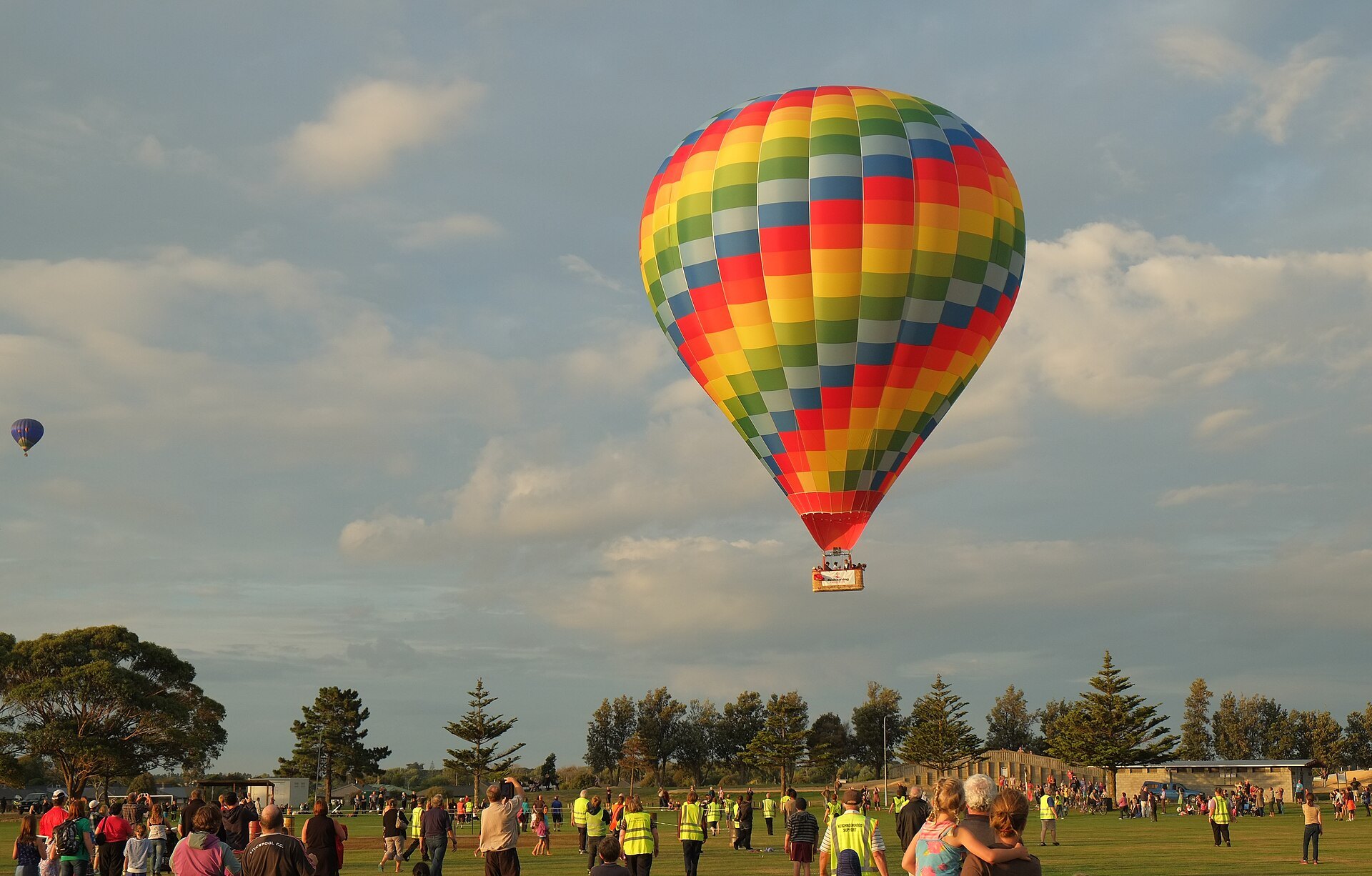

Ask anyone who has flown what surprised them most and the answer is rarely the take-off or the view. It is the landing. A balloon does not land on a runway, it does not land where it launched, and until about twenty minutes before touchdown nobody, including the pilot, knows exactly which field it will be. That sounds alarming and is in fact the most carefully managed part of the flight.
Choosing the field
A balloon can only steer by changing altitude to find a wind blowing in a slightly different direction, so the pilot has been thinking about the landing since before launch. The pibal test, the forecast and local knowledge give a likely track, and along that track the pilot knows the fields, the crops, the power lines and the farmers who welcome balloons and the ones who do not. In the last part of the flight the pilot is scanning for a field that is large enough, free of livestock, not sown with a standing crop, reachable by the chase vehicle and, ideally, downwind of nothing hard.
Power lines are the one hazard every pilot talks about. Balloons descend slowly and a pilot will always cross a line with height to spare, then come down on the far side.
The landing brief
A few minutes before the descent the pilot gives the landing brief, and it is worth listening to every word even if you have flown before, because every basket and every pilot differs slightly. The brief covers where to stand, what to hold, and what to do with cameras, which is to put them away. In most baskets each passenger faces away from the direction of travel, with their back against the basket wall, knees bent and both hands on the rope handles inside the basket. Nothing should be held outside the rim, elbows in, feet flat.
The pilot will tell you whether to expect a standing landing or a drag. Then comes the key instruction: stay in the landing position, and stay in the basket, until the pilot says you can stand and climb out. This matters because a basket that suddenly loses two passengers’ weight while the envelope is still full of hot air will lift again, sometimes with the remaining passengers in it and the pilot half out.
What the touchdown feels like
On a calm morning the envelope is cooled gradually, the basket sinks, the pilot pulls the vent line to spill hot air from the top of the envelope, and the basket settles onto the grass with a bump no worse than stepping off a kerb. It stays upright, and that is the majority of landings.
With more breeze, the basket touches down while still moving across the ground, bounces once or twice and then, as the envelope is pulled sideways by the wind, tips onto its side and slides. This is the drag landing, and it can carry the basket ten to fifty meters across a field before the pilot pulls the vent fully open and the envelope collapses. Passengers end up on their backs, stacked gently against the basket wall, looking up at the sky through a lattice of ropes. It is over in seconds, and provided you held on with knees bent it is a great story rather than an injury. Pilots use the drag deliberately in wind; a basket that lands upright and then tips is safer than one that catches an edge.
Either way, the envelope then lies stretched across the field like a huge bright tent, still with warm air in it, and the pilot walks the crown line to pull it flat.
The chase crew and the pack-up
All through the flight a crew has been following in a vehicle with a trailer, watching the balloon, reading the road map, and talking to the pilot by radio. Their job is to be at the landing field within minutes, sometimes before the basket has stopped moving, to hold the basket steady while the passengers climb out, and to organise the pack-up.
Passengers are usually invited to help, and we always say yes. It goes like this.
- The crew disconnects the burner and lays the basket on its side
- The envelope is squeezed from the crown end down toward the mouth to push the last air out
- Passengers stand along the fabric and walk it into a long sausage, holding it off the wet grass
- The crew stuffs the sausage into a bag the size of a large fridge, tail first
- The bag, the basket and the burner go onto the trailer
A full pack-up takes twenty to thirty minutes with willing hands and closer to an hour without them. If the field is wet, the envelope is spread out to dry later, because a damp envelope stored in its bag grows mildew and loses its coating.
The champagne, and where it comes from
Once the trailer is loaded, the tradition is a toast, and it has a real history. The first manned balloon flights took place in France in 1783, and the early aeronauts landed among rural people who had never seen an aircraft of any kind. Accounts from the period describe farmers attacking a landed balloon with pitchforks, believing it to be a monster or the devil. The story handed down among pilots is that aeronauts began carrying wine to offer the farmer on landing, as proof that they were ordinary Frenchmen and as thanks for the use of the field. The toast survived, and today most operators pour sparkling wine in the field, with a non-alcoholic option, and hand out a flight certificate.
Some crews add a short ceremony, a mock inauguration or a balloonists’ prayer, which varies by country. It usually ends with everyone slightly muddy, holding a plastic flute, watching the sun climb.
Landowner courtesy
You have landed in someone’s field. Most farmers are welcoming, some are paid a landing fee, and a few are tired of it. Pilots work hard to keep the relationship good, and passengers can help. Stay off any standing crop, close gates behind you, keep dogs in the vehicle, do not leave a cork or a bottle behind, and if the farmer walks over, say thank you. The pilot will often share the toast with the landowner, and that gesture is a direct descendant of the eighteenth-century bottle. It is also the reason there will be a field to land in next time.
