
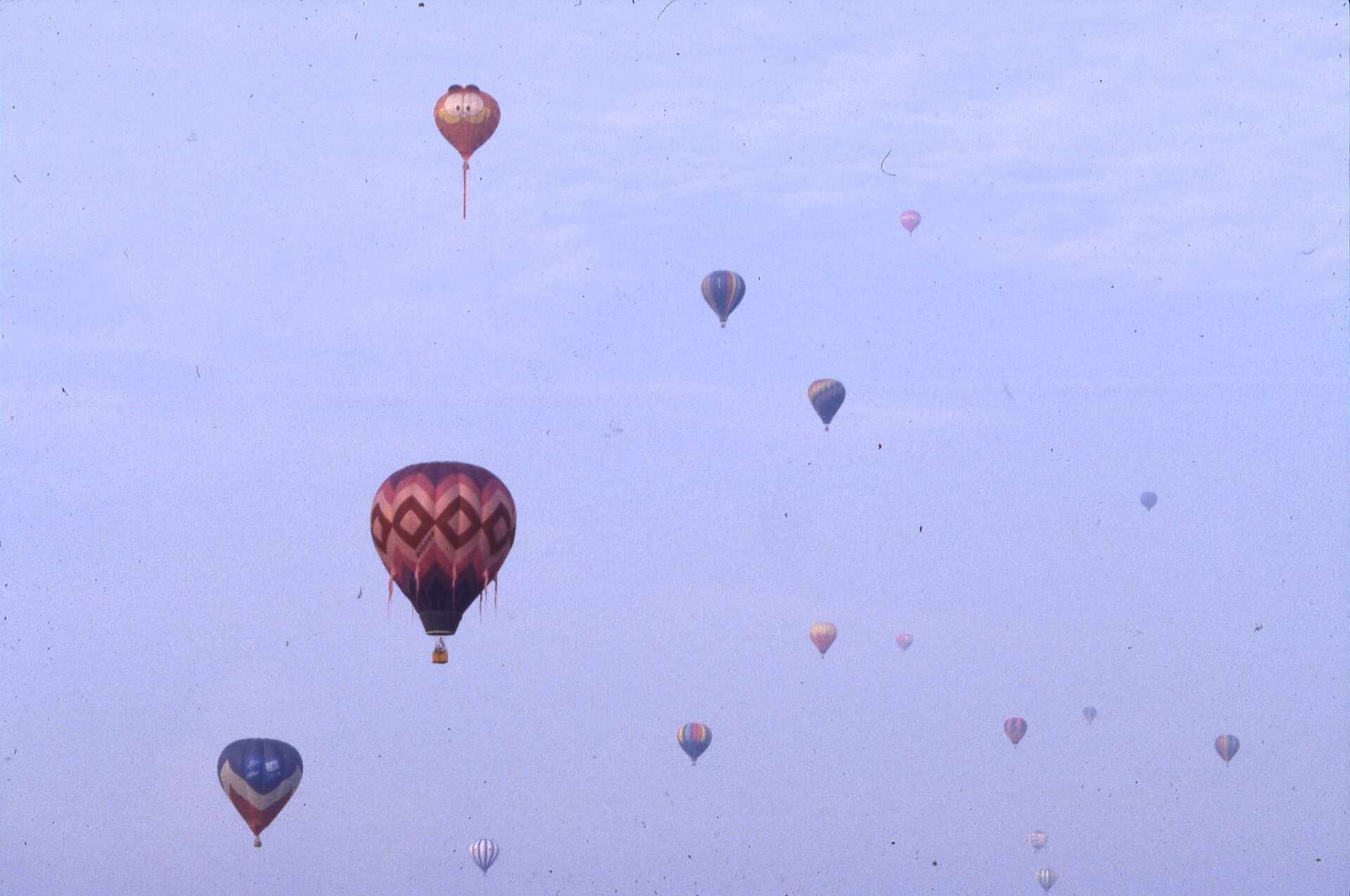

The most common question a balloon pilot hears, usually asked with a slightly worried look, is how you steer the thing. The honest answer is that you do not, at least not in the way a car or an aeroplane is steered. A balloon goes where the air goes. But the air does not go in only one direction, and a pilot who understands that has more control than the question implies. Steering a balloon is a matter of reading the wind at different heights and then choosing which of those winds to ride. It is the true craft of the sport and the part passengers almost never see.
The wind is not one thing
Air near the ground rarely moves in the same direction as the air a few hundred feet above it. Friction with the surface slows the lowest layer and, in the northern hemisphere, tends to turn it slightly to the left of the wind higher up. Cold air drains downhill at night and pools in valleys. Above that, the wind typically veers, that is, turns clockwise, and strengthens with height. On a calm morning the result is a stack of layers, each moving on its own heading at its own speed, sometimes differing by 90 degrees or more within the first 2,000 feet.
A balloon can move vertically, by heating the air in the envelope to climb or venting it to descend, and that is enough. Climb into a layer moving east and you drift east; descend into one moving north and you turn north. The art is knowing which layers are there before committing to them, since every change costs fuel and time.
Reading the sky before dawn
The work begins long before the burner is lit. Pilots study the winds aloft forecast, which in the United States gives predicted wind direction and speed at 3,000, 6,000 and 9,000 feet above sea level, and the surface forecast, and try to reconcile the two with what they can see and feel on the launch field. Smoke from a chimney, a flag, the movement of high cloud, dew on the grass and the direction a lake’s surface is ruffled all tell part of the story.
The most important tool is also the simplest. Shortly before launch the pilot releases a pibal, short for pilot balloon, a small helium balloon of the kind sold at fairs. At dawn it is often fitted with a tiny light so that it can be followed against a dark sky. The pilot watches it climb, noting the heading it takes in the first few hundred feet, the point at which it turns, and how fast it drifts at each stage. Where a pibal turns is where the layers change. A careful pilot may release two or three. That five-minute observation shapes the entire flight plan: where the balloon is likely to go, which fields lie under that track, and whether there is a layer that can bring it back if needed.
The Albuquerque box
The most famous example of layered wind is the pattern known as the Albuquerque box, which is why that city became the centre of the sport. On cool, clear mornings in the Rio Grande valley, cold air drains down the valley from the north at low level while the air a few hundred to a couple of thousand feet higher moves from the south. A pilot can launch, drift south at low altitude, climb, ride the upper flow back north, descend, and land close to the starting point. The result is a rectangular track in the sky, and in the right conditions pilots can fly it several times in a morning. Similar valley patterns exist elsewhere, but nowhere is the box so reliable or so well known.
Making the balloon do it
Knowing the layers is one thing; using them is another. A balloon has a great deal of inertia. When the pilot burns, the effect on the climb is felt perhaps 10 to 20 seconds later, and the balloon keeps rising after the burner stops. Skilled pilots burn in short measured bursts and anticipate, starting a climb before the turn is needed and stopping it before the target altitude is reached. Descents are made by letting the envelope cool, or by opening the parachute vent at the crown to spill hot air, and again the balloon responds slowly, so the pilot has to think a hundred feet ahead. Most sport flying happens between about 500 and 3,000 feet above the ground.
A good pilot also reads the ground for what it says about the next layer down. Treetops swaying, dust from a track, a line of ripples spreading across a pond, the lean of a flock of birds: all of these are wind reports, delivered free of charge, that tell the pilot what will happen on descent.
Chase crews and radios
While the balloon drifts, its crew follows by road. The chase crew watches the balloon, listens on a handheld radio or a phone, and tries to guess the landing site from the pilot’s altitude and track. The crew chief keeps the pilot informed of what the surface wind is doing on the ground and of any obstacles the pilot cannot see from above. A pilot who lands somewhere the crew cannot reach with a trailer has committed one of the small cardinal sins of the sport.
Choosing a field and landing well
The last few minutes of a flight bring the reading of the wind down to a single choice. The pilot needs a field that is large enough for the surface wind, free of power lines on the approach, not planted with a crop that a basket would flatten, without livestock, and reachable by road. Power lines are the greatest danger in ballooning, and pilots are taught to look for the poles rather than the wires, which are nearly invisible from above. In stronger wind the basket may tip and drag until the envelope is deflated, which is why passengers are briefed to bend their knees, hold on and stay in the basket.
Then comes the part no regulation covers. The field belongs to someone, and the sport survives on their goodwill. Pilots ask permission where they can, avoid crops and animals, close every gate they open, and leave the field as they found it. Many carry a small gift for the landowner, a bottle or a card, a custom as old as the sport itself. It works as well now as it did then.
