
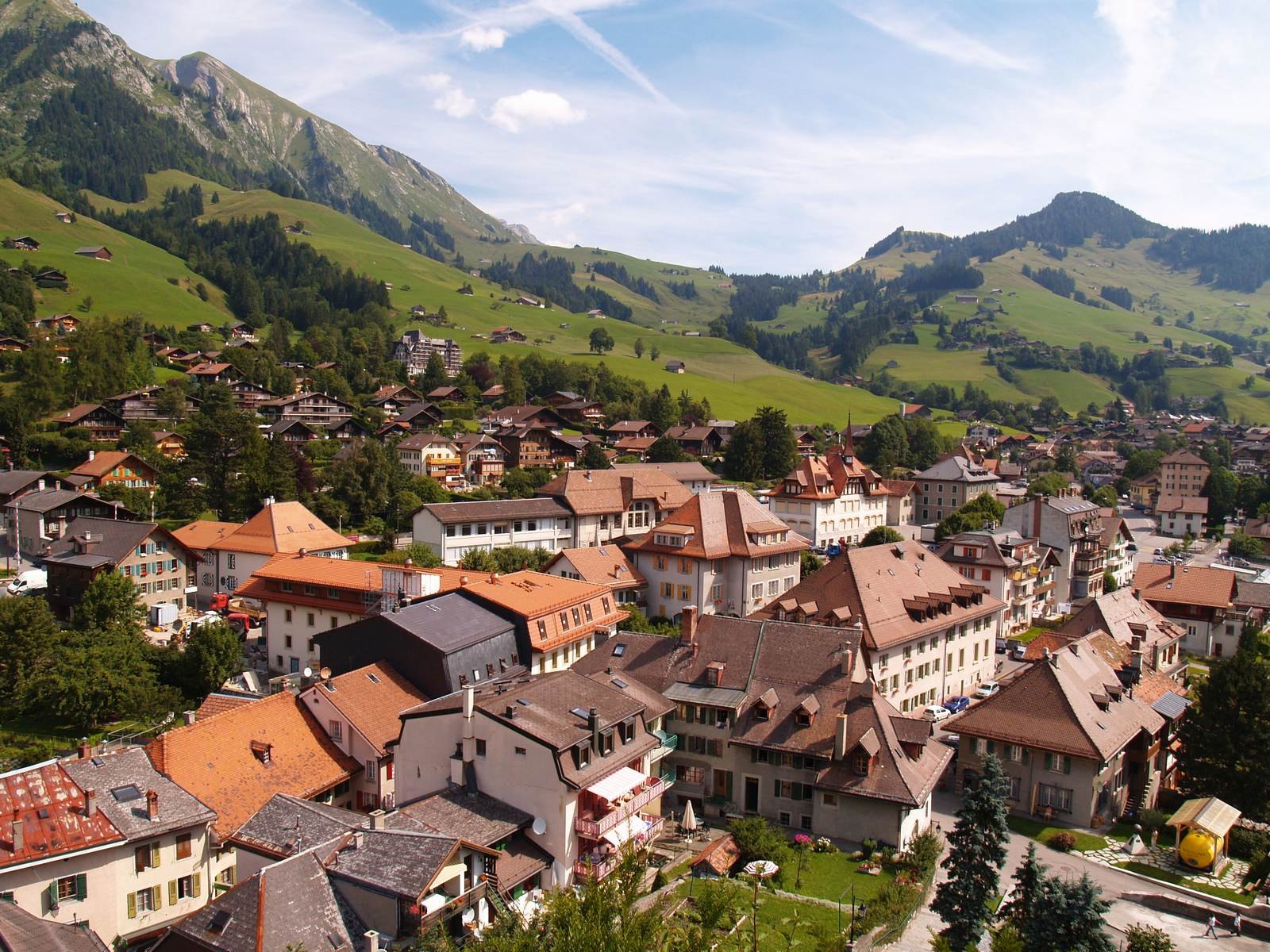

Every January, a village of about 3,500 people in the Swiss pre-Alps becomes, for nine days, the balloon capital of the world. Chateau-d’Oex sits at around 1,000 metres in the Pays-d’Enhaut, a high valley in the canton of Vaud between Gstaad and Montreux, and its International Hot Air Balloon Festival has run every winter since 1979. Pilots from twenty or so countries bring their balloons to fly among snow-covered peaks, and the public turn up in the thousands to watch. We have attended several times, and it remains our favourite festival anywhere: small enough to feel like a village fair, serious enough to attract the best mountain pilots in the sport.
A festival born of a valley’s microclimate
The festival exists because of geography. The Sarine valley at Chateau-d’Oex is broad and flat-bottomed, aligned roughly east to west, and in winter it sits under stable high-pressure air with very light winds at ground level. Pilots discovered in the 1970s that the valley offered something rare: dependable winter flying conditions in an alpine setting. The first festival in 1979 gathered a handful of balloons. Today it draws around 70 to 90, and the village has built an identity around it, including a small museum, the Espace Ballon, devoted to the history of lighter-than-air flight.
The place also has a claim on aviation history. It was from a field in Chateau-d’Oex that the first non-stop balloon flight around the world set off on 1 March 1999, landing in the Egyptian desert twenty days later. A monument marks the spot, and the story is told with some pride in the museum.
Flying between mountains
Mountain ballooning is a discipline of its own, and watching it is a large part of the festival’s appeal. In the flat lands, a pilot rises and drifts. Here, the air moves in layers that follow the terrain: cold air pooling in the valley floor, a gentle drainage wind down the slopes in the early morning, and above the ridges, the general wind that may blow in a completely different direction. Skilled pilots use these layers like lifts and corridors, climbing to catch a current that carries them along the valley, then descending to find air that brings them back. On the best days the balloons seem to hover over the village for an hour, rising and falling against the white slopes of the Vanil Noir and the Rocher du Midi.
Launches happen mid-morning, typically from about 10:00 when the sun has taken the edge off the cold, from the main field beside the village. There is a mass ascent on the opening and closing weekends, and on the days between there are competition tasks, tethered flights for children, and, wind permitting, long-distance flights that cross the ridges toward Gstaad or down the valley toward Lake Geneva. Flight altitudes range from a few metres above the snow to 2,500 or 3,000 metres over the passes, and the pilots who go high need oxygen and serious clothing.
The night glow
The signature evening of the festival is the night glow, usually held on the middle Saturday. As dusk falls, a dozen or more balloons are inflated on the field but held tethered to the ground, and the pilots fire their burners in sequence to music, so that the envelopes light up from inside like enormous paper lanterns against the dark mountains. The show lasts around half an hour and is followed by fireworks. Some years add special-shape balloons to the line-up, so that a cartoon animal or a giant bottle glows next to the classic teardrops, to the delight of the children in the crowd. It is bitterly cold, the crowd is large and the atmosphere is unlike anything else in the sport. Arrive early, bring a thermos, and stand on the slope above the field for the best view.
How to attend, and how to fly
The festival takes place over the last full week of January, from a Saturday to the following Sunday. Entry to the launch field is charged at a modest daily rate, a few francs, with children free or reduced. The village itself is small, so accommodation fills early; the hotels and chalets of Chateau-d’Oex, Rougemont and Rossiniere are the closest, and Gstaad, 15 kilometres away, has plenty more. Day trips are perfectly possible from Montreux or even Lausanne, and the trains are timed so that a morning launch and an afternoon return are easy.
- Full winter clothing: the field is in shadow until mid-morning and temperatures of minus 10 degrees C are normal.
- Boots with grip; the ground is packed snow and ice.
- Sunglasses and sunscreen for the glare once the sun is on the snow.
- Cash in Swiss francs for entry, food stalls and the museum.
Passenger flights are available during the festival and are, for many visitors, the point of the trip. A shared flight of around an hour costs in the region of 400 to 500 Swiss francs per person, about 450 to 560 US dollars or 420 to 520 euros, and must be booked well in advance through the festival organisation. Places are limited and weather cancellations are refunded or rebooked. A flight between the peaks, landing in a snowy meadow with the burner steaming in the cold, is one of the great experiences in ballooning.
Getting there
Chateau-d’Oex is on the GoldenPass railway line between Montreux and Zweisimmen, one of the most scenic in Switzerland. From Montreux, on the shore of Lake Geneva, the train climbs through the vineyards and over the Col de Jaman in about an hour. Montreux itself is around an hour from Geneva airport by direct train, so the whole journey from the airport takes a little over two hours without a car. Drivers take the motorway to Aigle or Bulle and then the mountain road; winter tyres are essential and chains may be required. Parking in the village is limited on festival weekends, and the railway is the easier option.
Whether you fly or simply watch, Chateau-d’Oex in the last week of January is the sport at its most beautiful. Snow, silence, and a sky full of colour over a valley that has welcomed balloons for nearly half a century: we would not miss it.
