
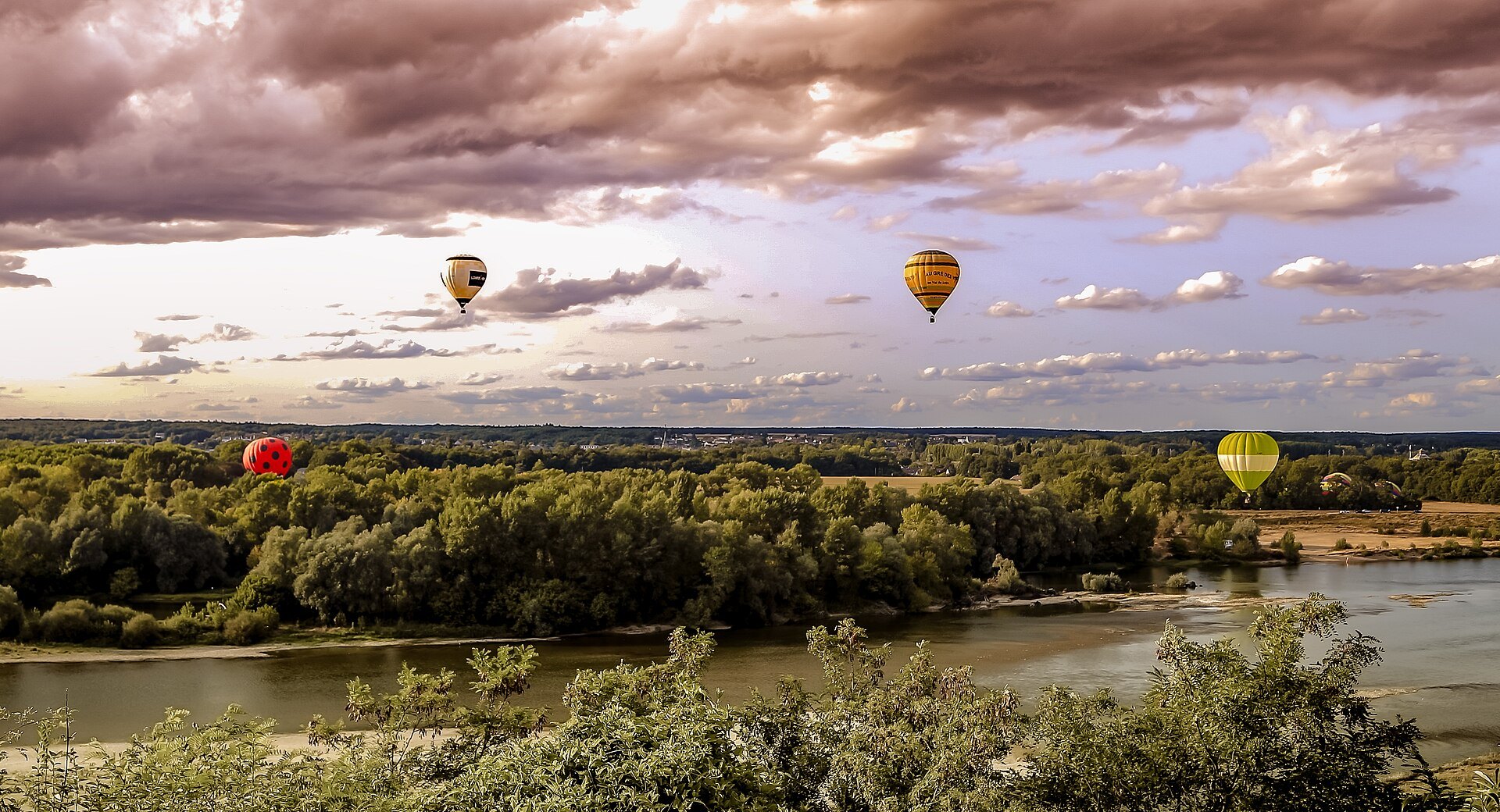

Ballooning was born in France, and there is a good argument that the Loire Valley is where it is still practised most gracefully. The river runs slow and wide between Orleans and Angers, the light is famously soft, and every few kilometres a chateau sits in its park as if placed there for someone flying overhead. Add the vineyards of Touraine, the poplar lines along the Cher, and the small villages of tufa stone, and you have a landscape that seems designed to be seen at walking pace from a few hundred metres up. We have flown here in spring and at harvest, in the morning and at dusk, and we keep coming back.
Three chateau regions, three different flights
The valley is long, and balloon launch sites are spread along it, so the first decision is which stretch to fly. The most popular is the area around Amboise and Chenonceau, on the Loire and its tributary the Cher. Chenonceau is the one everyone wants: a 16th-century chateau built on arches directly across the river, so that from the air it looks like a bridge that grew a palace. Balloons launch from fields nearby and, when the wind cooperates, drift across the Cher with the chateau and its formal gardens directly below. Amboise, a few kilometres north, gives you the royal chateau on its bluff above the Loire and the little manor of Clos Luce, where Leonardo da Vinci spent his last years and died in 1519.
The second region is around Chambord and Blois, upstream to the east. Chambord is the giant of the valley, a hunting palace begun in 1519 for Francois I with more than 400 rooms and a roofline of towers and chimneys that looks, from above, like a small town. It sits in a walled forest park of more than 5,000 hectares, and flights here are as much about the woodland, the deer and the long straight rides as about the building. Blois, with its royal chateau, Cheverny, still lived in by the same family since the 17th century, and Chaumont, with its garden festival, are all within range of the same launch fields.
The third, quieter option is the western valley around Saumur and Chinon, with troglodyte villages, the Fontevraud abbey and the wine country of Saumur-Champigny. Fewer balloons fly here, the crowds are thinner, and the river islands and sandbanks are at their most beautiful.
Evening flights and the river light
Most balloon destinations are strictly a dawn affair. The Loire is one of the few where the evening flight is a genuine alternative and, in our view, often the better one. Between April and October, pilots fly in the last two hours before sunset, when the thermals of the afternoon have died down and the air over the river is calm. The light at this hour is what painters came here for: low, golden and slightly hazy, so that the chateaux glow and the river turns to pewter. The evening also suits travellers who would rather not set an alarm for five. Morning flights exist too, and they have their own charm, with mist lying in the river channels and the vineyards still wet. If you can, do both.
A typical flight lasts an hour, sometimes a little more, from launch fields chosen on the day for the wind. Cruising heights vary from treetop level along the river, low enough to hear the church bells, to 500 metres or so for the long views over the patchwork of vines, wheat and sunflowers. Landing is in a farmer’s field, followed, in the French tradition, by a glass of local sparkling wine and a short ceremony in which first-time flyers are inducted into the fellowship of the air.
Seasons and the vineyards
The flying season runs from April to the end of October, with occasional flights in the shoulder months if the weather is kind. Spring brings blossom in the orchards and fresh green in the vines. High summer is reliable and warm, with long evenings, though July and August are also the busiest and the air can be hazy. Our favourite is September, when the grape harvest is under way in the Vouvray, Montlouis, Touraine and Cheverny vineyards and the rows are full of pickers and tractors. The leaves start to turn in October, and the last flights of the year, over yellow vines under a pale sky, are among the loveliest.
Prices, what to bring and how to get there
The Loire is good value by international standards. Expect roughly 200 to 300 euros per person for a shared basket of six to twelve people, with private flights for two starting from around 500 to 600 euros. Many launches are within a few kilometres of the major chateaux, so you can combine a flight with a day of visits.
- A light jacket, even in summer: the evening air cools quickly after landing.
- Flat, closed shoes for the fields, which may be muddy in spring.
- A hat for morning flights, and sunglasses for the evening glare off the river.
- A camera with a moderate zoom; the chateaux are close, but not directly under you every time.
From Paris, the fastest route is the high-speed train from Montparnasse to Tours (Saint-Pierre-des-Corps) in a little over an hour, then a hire car or a short local train to Amboise or Blois. Blois is also reached directly from Paris Austerlitz in about an hour and a half. A car is useful because launch sites move with the wind and are rarely in town. Tours has a small regional airport, and Paris, Nantes and Orleans are the practical alternatives.
Why we rate it
The Loire does not have the drama of mountains or the spectacle of a mass launch. What it offers instead is a kind of civilised perfection: a slow river, a great house every few minutes, vines to the horizon and a glass of something cold in a field at sunset. It is the flight we recommend to people who are nervous, to couples, and to anyone who thinks ballooning is only about Cappadocia. It is also, not incidentally, the place where the whole thing began, and the pilots here know it.
