
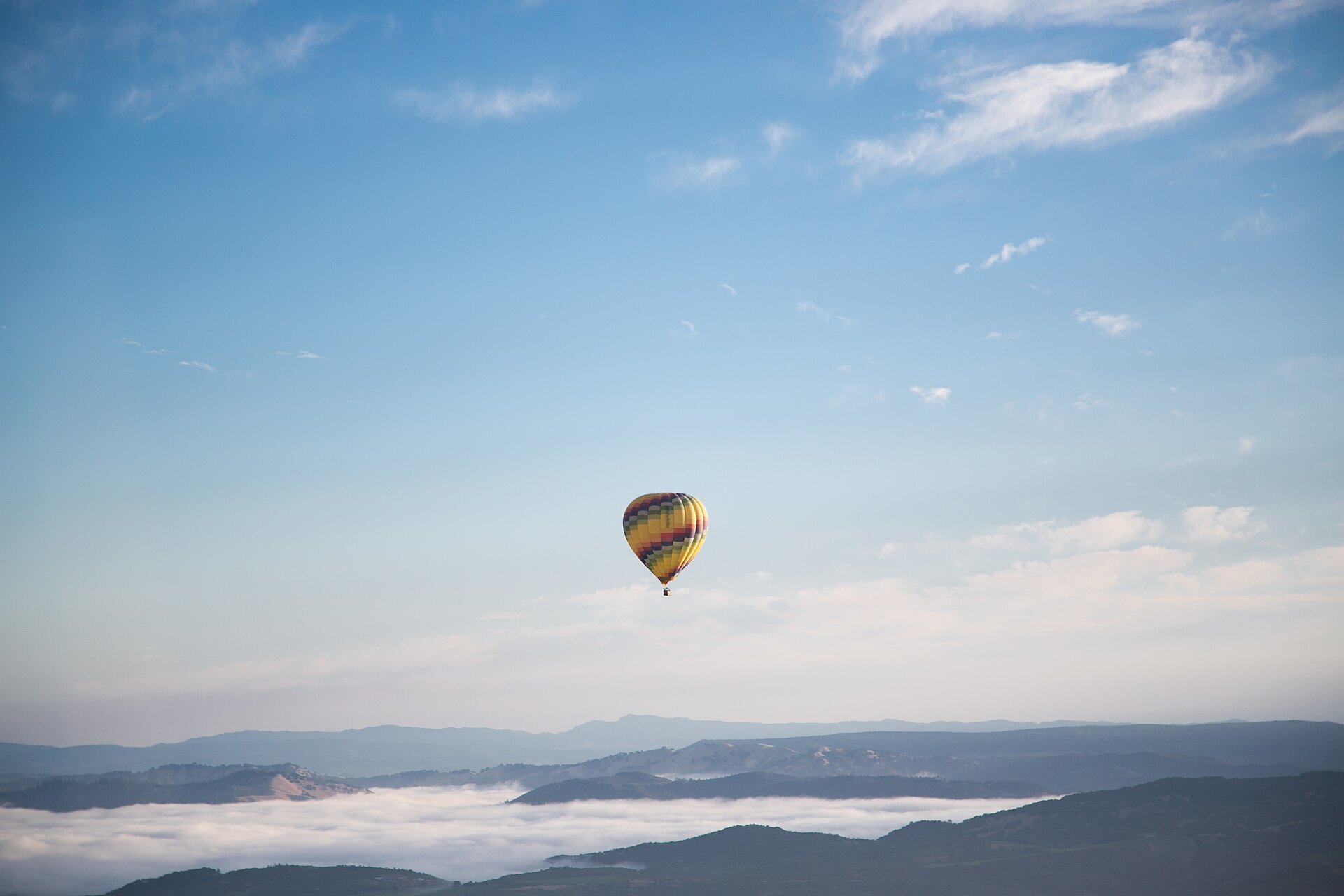

Wine country and balloons have a long relationship, and in California it is a marriage. The Napa Valley, an hour and a half north of San Francisco, has hosted commercial balloon flights since the 1970s, longer than almost anywhere in the United States, and on a clear morning in September there may be a dozen envelopes in the air at once over the vineyards. The Sonoma side, to the west, is quieter, greener and closer to the ocean, and its own flights launch from the Russian River valley. Between the two you have a choice of flights that are civilised, reliable and, thanks to the fog that rolls in from the Pacific, occasionally surprising. This is our guide, fog run included.
Yountville and the valley floor
Napa is a narrow valley about 50 kilometres long, running north-west from the town of Napa to Calistoga between two ranges of hills, the Mayacamas to the west and the Vaca to the east. Most balloon launches take place around Yountville, in the middle of the valley, from vineyard edges and open lots on the outskirts of the village. Yountville is small, walkable and very good at breakfast, which matters here. From the launch field, the balloon rises over rows of cabernet, merlot and chardonnay planted in neat blocks, with the valley road running up the centre and the wineries, some of them grand stone buildings, some of them barns, dotted along it.
A typical flight lasts about an hour, and pilots work the layered air of the valley to move up and down it. Altitude ranges from just above the vines, low enough to wave to the picking crews, to 600 metres or more, where the view opens to the whole valley, the hills on both sides, the marshes of San Pablo Bay at the southern end, and on very clear days the towers of San Francisco 70 kilometres away. Landing is in a vineyard road or a mown field, negotiated by radio with a helpful landowner, and the ground crew follows in vans.
Morning fog and the fog run
The Pacific is the valley’s air conditioner. Cold ocean water off the California coast chills the air above it, and each night that marine layer slides inland through the Golden Gate and across San Pablo Bay, filling the southern Napa Valley and much of Sonoma County with low cloud. By dawn, the valley floor is often under a grey blanket a few hundred metres thick, which burns off by mid-morning. This is what makes the wine good, cool nights and warm days, and it is also what makes the flying interesting.
When the fog is thin or patchy, balloons launch into it and climb through to emerge into sunshine above a white sea, with the ridgelines standing out like islands. It is the most beautiful view in the region, and it is a matter of luck. When the fog is too thick or too low at Yountville, operators do what the locals call the fog run: passengers are driven north, sometimes 30 or 40 minutes, to an alternative launch site beyond the fog line, often in the upper valley near Calistoga or over the hills in Pope Valley, where the sky is clear. The flight is just as good, the landscape is wilder, and you get to watch the fog from the outside. A fog run is not a downgrade, though it does make for a longer morning. Fog is most frequent in summer, from June to August, and rarest in the autumn and spring.
Harvest season and the rest of the year
Flights run all year in Napa and Sonoma, one of the few places in the northern hemisphere where that is true. The best months are September and October, the harvest, when the vines are heavy with fruit, the crews are out before dawn under floodlights, and the smell of crushed grapes drifts up to the basket. The leaves turn red and gold in late October and November, which is our favourite time for photographs. Winter, from December to February, is the rainy season, with more cancellations but the greenest hills and the clearest air between storms. Spring brings mustard flowers in yellow carpets between the rows. Summer is reliable and warm, but the fog run is most likely then.
The brunch tradition
Napa refined the old French custom of a glass of champagne after landing into a full occasion. Most flights end with a brunch, either at a restaurant in Yountville or the town of Napa or under a tent at the landing site, with sparkling wine from the valley, eggs, pastries and fruit. It is as much a part of the morning as the flight, and a good place to swap stories with the passengers from the other baskets. Sonoma flights, launching from around Windsor and Santa Rosa, tend toward a lighter picnic breakfast in a vineyard. Either way, do not plan lunch.
Prices, packing and getting there
Expect 250 to 400 US dollars per person, roughly 230 to 370 euros, for a shared flight of eight to twelve passengers with brunch included. Smaller baskets and private flights for two cost considerably more. Sonoma is usually a little cheaper than Napa.
- Layers: a fleece for the launch, which is cool and damp under the fog, and a T-shirt for the brunch in the sun.
- Closed, flat shoes for vineyard rows and wet grass.
- A hat with a brim, because the burner is directly overhead.
- A camera and a lens cloth for the condensation when you climb out of the fog.
From San Francisco, drive north over the Golden Gate Bridge and up Highway 101 to Sonoma, or across the Bay Bridge and up Interstate 80 to Napa; either takes about 90 minutes without traffic. San Francisco, Oakland and Sacramento airports are all within two hours. Pick-ups are between 5:00 and 6:00 depending on the season, so staying in Yountville, Napa or Healdsburg the night before is strongly advised. A hire car is essential; there is no useful public transport to the launch fields.
Wine country ballooning is not wild, and it does not pretend to be. It is a slow drift over one of the most carefully tended landscapes on Earth, with a glass of something cold at the end. On a morning when you climb through the fog into the sun, it is also one of the loveliest sights in the sport.
