
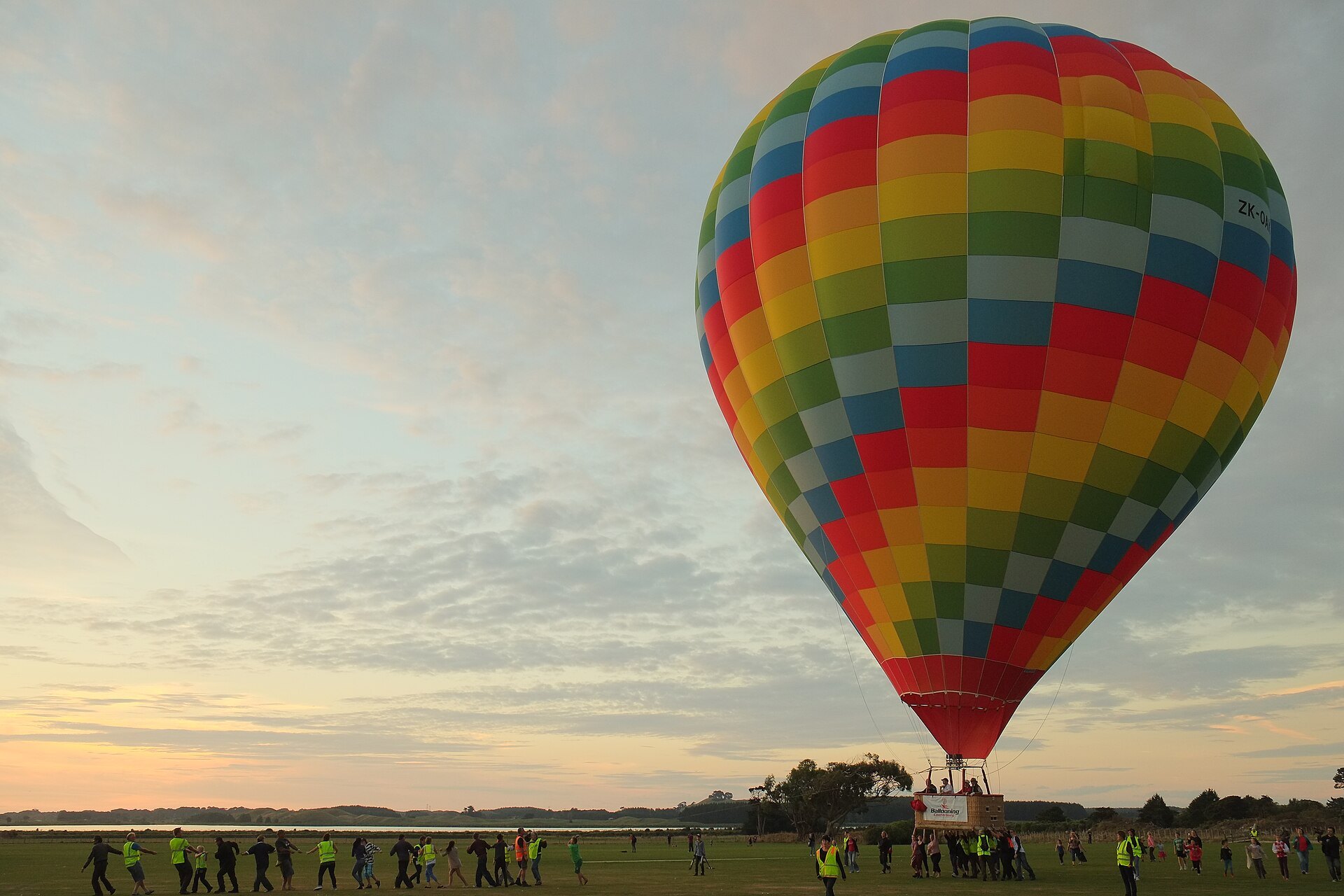

New Zealand is a country of dramatic air. Wind pours off the Southern Alps, weather arrives from the Tasman Sea with no warning, and the landscape changes from glacier to vineyard in an hour’s drive. It is not, on the face of it, an obvious place for a sport that depends on calm mornings. And yet the South Island has one of the most rewarding balloon flights we know, over the Canterbury Plains near the small town of Methven, with the full wall of the Alps standing to the west. This is our guide to flying there, and to why the winter frost mornings are the ones to aim for.
Canterbury: the plains and the mountains
The Canterbury Plains are the largest area of flat land in New Zealand, a wedge of gravel and farmland about 180 kilometres long that runs from the Pacific coast inland to the foothills of the Alps. Braided rivers such as the Rakaia and the Rangitata cross them in wide grey beds of shingle, splitting and rejoining in channels that look, from above, like the veins of a leaf. Balloon flights launch from farmland around Methven, an hour and a half south-west of Christchurch, at the point where the plains stop and the mountains begin. Mount Hutt, with its ski field, rises directly behind the town to just over 2,000 metres, and on a clear day the view along the range reaches Aoraki, Mount Cook, the country’s highest peak, more than 100 kilometres away.
The flight profile suits the geography. Pilots climb early to 1,000 metres or more to open up the panorama of the whole range, snow-capped from autumn to spring, then descend over the farms for the detail: hedgerows of pine and macrocarpa planted as shelter belts, circular irrigation pivots, flocks of sheep and herds of dairy cows, and the improbable blue-grey of the Rakaia where it braids across the gravel. Flights last about an hour, and the whole excursion, with pick-up, inflation, flight and the breakfast afterwards, takes three to four hours. Landing is on a paddock somewhere downwind, with the farmer’s permission sought by radio, and a friendly dog is usually first on the scene.
Winter frost flights
Ballooning in Canterbury runs all year, which is unusual, but the season we recommend is the southern winter, June to August. It sounds perverse to get up in the dark in the coldest months, and the drive to the launch field over frosted roads is not for everyone. The reward is air of extraordinary stillness and clarity. Winter high-pressure systems over the South Island produce windless mornings with visibility of 150 kilometres or more, and the plains are white with hoar frost, every fence post and shelter belt outlined in ice. The Alps are at their snowiest. The sun comes up late, around 7:45 in June, so launch is at a civilised 7:00 rather than five, and the light stays low and golden for most of the flight.
The cold is real. Ground temperature at launch can be minus 5 degrees C, and the basket climbs into air that is not much warmer, though the burner above your head helps. Dress as you would for a morning on a ski field and you will be comfortable. Summer flights, from December to February, launch much earlier, around 5:30, to beat the north-westerly winds that build later in the day, and cancellations are more common in the warm months for that reason.
Queenstown and the rest of the South Island
Many visitors arrive expecting to balloon in Queenstown, the adventure capital on Lake Wakatipu. It has been done, and the views over the lake and the Remarkables are extraordinary, but the terrain and the local wind patterns make regular commercial flights difficult, and availability there has come and gone over the years. If a flight is on offer during your visit, it is worth taking. Otherwise, treat Canterbury as the reliable option, and note that Methven is about five hours’ drive north of Queenstown, on a route that passes Lake Tekapo and the Mackenzie Basin, which is itself among the finest drives in the country. Flights are also occasionally offered in Hawke’s Bay and the Waikato on the North Island, but the alpine backdrop is a South Island speciality.
Prices, packing and getting there
A shared flight over the Canterbury Plains costs around 400 to 500 New Zealand dollars per person, which is roughly 240 to 300 US dollars or 220 to 280 euros at recent exchange rates, including the post-flight breakfast and a glass of sparkling wine. Private baskets for two are available at a premium. Baskets here are small, typically four to ten passengers, which makes for a more personal flight than the big commercial rides elsewhere.
- A warm hat, gloves and a windproof outer layer in winter; a fleece even in summer.
- Sturdy closed shoes: the launch and landing fields are working farmland and may be frozen or muddy.
- Sunglasses; the glare off snow and frost is intense once the sun is up.
- A wide-angle lens for the range, and a spare battery, because cold drains them fast.
Christchurch is the gateway, with international flights from Australia and Asia and domestic connections from Auckland and Wellington. From the city, State Highway 1 south and then inland brings you to Methven in about 90 minutes by car; there is limited public transport, so a hire car is the practical choice. Many people stay in Methven itself, which has a good range of lodges and motels because of the ski season, or in the small towns of Ashburton and Rakaia on the plains. Staying locally means the pre-dawn pick-up is short.
Our verdict
Canterbury will never be the busiest balloon destination in the world, and that is exactly the appeal. A single balloon, a farm gate, a frost-white plain and a hundred kilometres of snow mountains catching the first light: it is ballooning stripped back to the essentials. Go in winter, wear everything you own, and stand very still while the pilot lets the burner go quiet. The silence over the Rakaia at sunrise is worth the flight on its own.
