
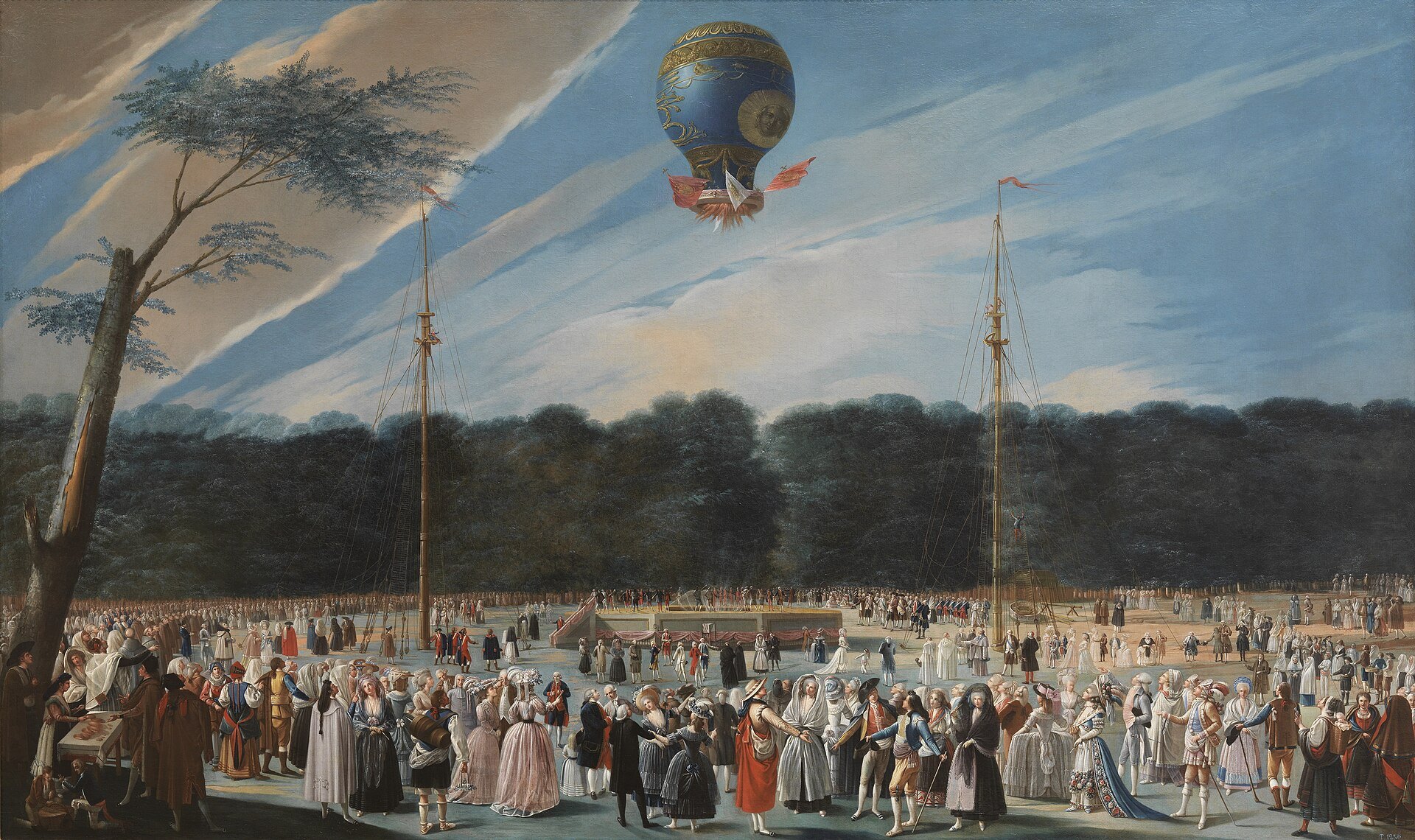

In the space of six months in 1783, human beings went from never having left the ground to flying across Paris in front of hundreds of thousands of witnesses. The story belongs to two paper manufacturers from a small town in the Ardeche, a physics professor working with two brothers who built scientific instruments, and a pair of volunteers brave enough to stand in a wicker gallery above an open fire. We return to it often, because much of what we do at a launch field today began that year.
Two Brothers and a Paper Mill in Annonay
Joseph-Michel Montgolfier, born in 1740, and his younger brother Jacques-Etienne, born in 1745, were sons of a prosperous paper-making family at Vidalon, near Annonay, some 70 kilometers south of Lyon. Joseph was the dreamer, disorganized and endlessly curious; Etienne, trained as an architect in Paris, was the methodical one who ran the mill. Late in 1782 Joseph filled a small box of thin silk with hot air and watched it rise to the ceiling of his lodgings in Avignon. The brothers repeated the trial with larger paper and cloth envelopes through the winter and became convinced, wrongly but usefully, that the lifting force came from a special gas contained in smoke. They burned damp straw and wool to produce as much of it as possible. The smoke did nothing, but the fire heated the air, and the heated air worked.
On 4 June 1783 they gave their first public demonstration in the market square of Annonay before the assembled notables of the province. The envelope, roughly 11 meters across and made of sackcloth lined with paper, held together with some 1,800 buttons, was filled over a fire pit. It rose to an estimated 1,000 meters, drifted for about ten minutes and came down in a vineyard two kilometers away. A written report went to the Academy of Sciences in Paris, and the race was on.
The Rivals: Charles and the Hydrogen Balloon
The Academy asked the physicist Jacques Alexandre Cesar Charles to investigate. Charles assumed, reasonably, that the Montgolfiers had used “inflammable air”, hydrogen, known to be far lighter than air. With the brothers Anne-Jean and Nicolas-Louis Robert, who devised a way of coating silk with dissolved rubber to make it gas-tight, Charles built a four-meter sphere and filled it with hydrogen produced by pouring sulfuric acid over half a ton of iron filings. On 27 August 1783 it rose from the Champ de Mars and vanished into the clouds. Forty-five minutes later it landed 21 kilometers away at Gonesse, where terrified villagers attacked the thing with pitchforks and dragged it through the fields behind a horse.
A Sheep, a Duck and a Rooster at Versailles
Etienne, by then in Paris, had the backing of the wallpaper manufacturer Jean-Baptiste Reveillon, whose workshop in the Faubourg Saint-Antoine became the first balloon factory. A demonstration for Louis XVI and Marie-Antoinette was fixed for 19 September 1783 at Versailles. Nobody knew whether living creatures could survive at altitude, so a sheep, a duck and a rooster were placed in a round basket slung beneath the envelope: the sheep as a stand-in for a human, the duck and the rooster as controls. The balloon, painted blue and gold and about 18 meters tall, rose in front of the palace, stayed aloft roughly eight minutes and came down gently in the woods of Vaucresson, three kilometers away. All three passengers were fine, apart from the rooster, which had been kicked by the sheep before takeoff. The sheep was retired to the royal menagerie under the name Montauciel, “climb to the sky”.
21 November 1783: The First Free Flight
The king’s first idea was to send up two condemned prisoners. Jean-Francois Pilatre de Rozier, a 29-year-old science teacher from Metz, argued that the honor should not go to criminals and volunteered himself. He made a series of tethered ascents in Reveillon’s garden during October, and he was joined by an infantry officer, Francois Laurent, Marquis d’Arlandes.
The balloon built for them was the largest yet, about 23 meters high and 14 meters wide, holding roughly 1,700 cubic meters of hot air. A circular wicker gallery ran around the base of the envelope, with a brazier hanging in the opening between the two men. On the afternoon of 21 November 1783 it rose from the garden of the Chateau de la Muette and drifted southeast across the city. Pilatre de Rozier kept shouting at d’Arlandes to stop admiring the view and pitch more straw onto the fire; d’Arlandes spent much of the flight sponging out small holes that sparks were burning in the fabric. After about 25 minutes and roughly nine kilometers they landed on the Butte-aux-Cailles, having reached perhaps 900 meters. Nobody had ever left the earth in free flight before.
1 December: Charles Flies, and the Two Designs Part Ways
Ten days later Charles answered. On 1 December 1783, before a crowd estimated at 400,000, he and Nicolas-Louis Robert took off from the Tuileries gardens in a hydrogen balloon that already had every feature a modern gas balloon carries: a net over the envelope to spread the load, a valve at the top to release gas, sandbags for ballast and a barometer to read the altitude. They flew for two hours and landed 36 kilometers away at Nesles-la-Vallee. Charles then went up again alone, climbed to about 3,000 meters in ten minutes, saw the sun set for a second time that evening, and came down half-frozen. He never flew again.
Why the Montgolfiere Worked, and Why It Was Left Behind
The physics is simple. Air expands when heated, so a given volume of hot air weighs less than the same volume of cold air, and the difference is the lift. At 100 degrees Celsius air is roughly a quarter lighter than on a cool day, which is why the envelope had to be so enormous. Their fuel made things worse: straw burns fast, smoke clogged the envelope, and the paper-lined fabric was one spark away from disaster. Hydrogen, by contrast, gave far more lift per cubic meter and stayed put for hours. For the next 170 years the gas balloon was the serious aeronaut’s tool and the montgolfiere a fairground curiosity. Pilatre de Rozier himself died on 15 June 1785 with his companion Pierre Romain, attempting to cross the English Channel in a hybrid of the two designs. Only the propane burner and nylon fabric of the late 1950s would give the hot air balloon its second life, the one we fly today.
