
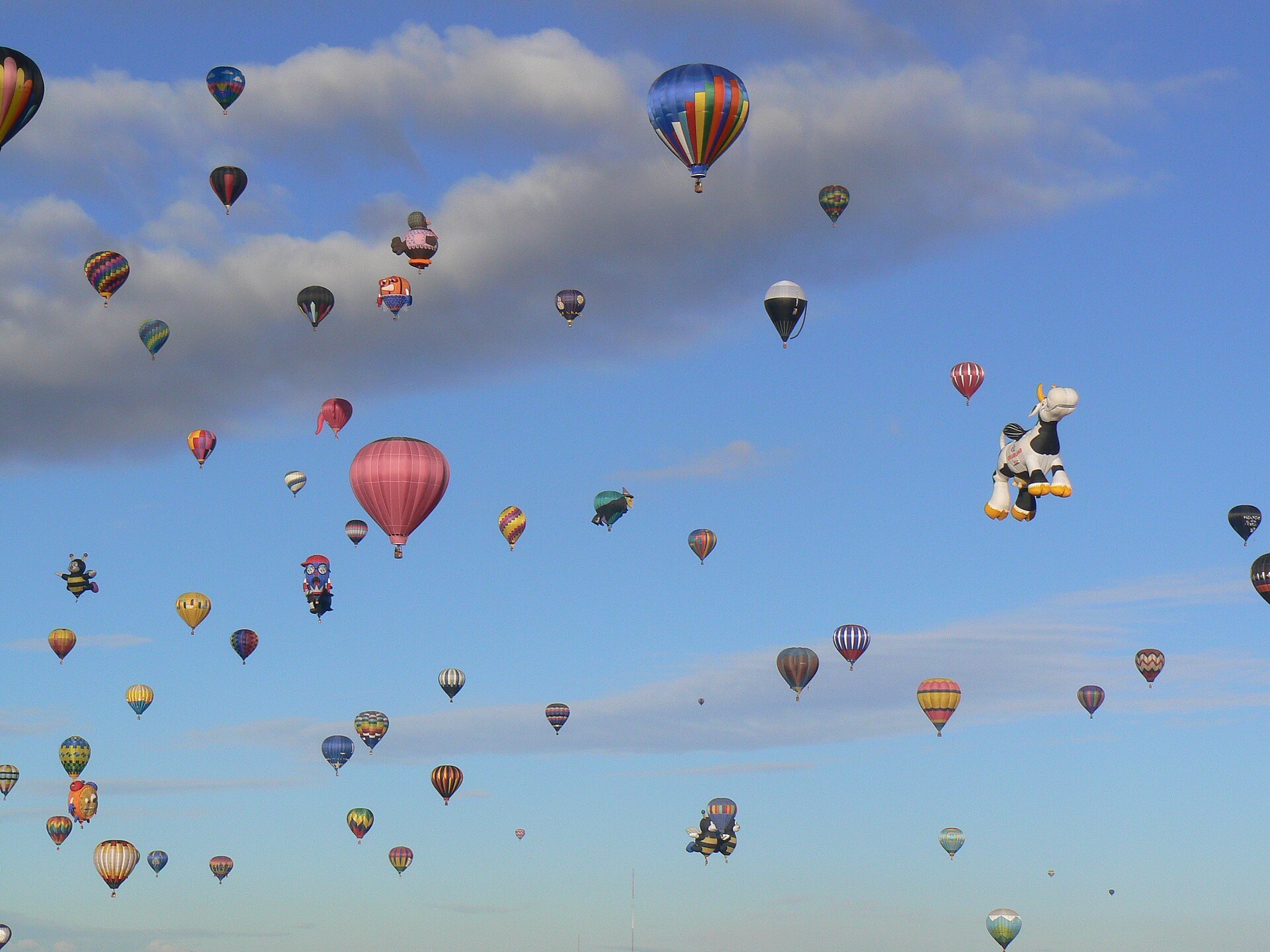

Every October, for nine days, a dusty field on the north side of Albuquerque, New Mexico, becomes the busiest balloon airport on earth. Five hundred or more envelopes inflate shoulder to shoulder in the dark, and when the launch directors wave them off, the sky over the Rio Grande valley fills with color from horizon to horizon. Seen from the field, it does not feel quite real. Here is how the gathering came about, why it works so well in this particular place, and how to see it properly.
From a Shopping Mall Parking Lot to the World’s Largest Gathering
The Fiesta began in April 1972, when a local radio station wanted a spectacular way to mark its fiftieth anniversary and asked Sid Cutter, an Albuquerque businessman and pilot, to organize a balloon race. He hoped for a couple of dozen balloons; thirteen made it to the parking lot of the Coronado Center shopping mall, and something like 20,000 people turned up to watch. The following year Albuquerque hosted the first World Hot Air Balloon Championship with 138 balloons, and the event never looked back. It moved between sites as it grew, peaking at more than 1,000 registered balloons in 2000 before the organizers capped the field at around 550 to 600 for safety. Since 1996 it has been held at Balloon Fiesta Park, 365 acres with a launch field of 78 acres, about the size of 54 football fields. Next to it stands the Anderson-Abruzzo Albuquerque International Balloon Museum, named for the two local pilots, Maxie Anderson and Ben Abruzzo, who with a third crew member made the first crossing of the Atlantic by balloon in 1978 aboard Double Eagle II.
The Albuquerque Box
The reason the Fiesta took root here rather than anywhere else is a quirk of geography. Albuquerque sits at about 1,600 meters in a broad valley with the Sandia Mountains rising to 3,200 meters on the east. On clear, still October mornings, cold air drains off the high ground overnight and flows south down the Rio Grande valley at low level, while a few hundred meters up the prevailing wind blows from the south. A pilot can launch, drift south on the surface flow, climb into the upper layer, ride it back north, and descend to land close to where the flight began. Locals call the pattern the Albuquerque Box, and it is why you will see balloons at the Fiesta passing each other in opposite directions at different heights. The box does not form every morning; when it fails, the balloons simply drift across the city and land in schoolyards, parks and cul-de-sacs.
What Happens During the Nine Days
The Fiesta runs from the first Saturday in October through the following Sunday, and every day follows the same rhythm. Around 6 am the Dawn Patrol goes up: a dozen balloons that launch in darkness, glowing like lanterns, to test the winds for everyone else. Then, weather permitting, comes the Mass Ascension, when the whole field launches in two waves over about two hours, marshalled by launch directors in black-and-white striped shirts whom everyone calls zebras. Mass ascensions are held on both weekends and on some weekdays; other mornings are given to competitions in which pilots try to drop markers on targets or snatch keys from the top of a pole. The Special Shapes Rodeo, usually on the Thursday and Friday mornings, sends up more than a hundred balloons built as cows, cartoon characters, bees, castles and a much-loved pig. The evening sessions are different: at a Balloon Glow, the envelopes are inflated but stay tethered to the ground and are lit from inside in unison by their burners, and the Special Shape Glowdeo does the same with the shapes, before fireworks close the night. Most years a long-distance gas balloon race also departs from the field.
How to Attend Without Regretting It
The single most important piece of advice is to arrive early, and by early we mean between 4:30 and 5:00 am. Gates open at 4:30 for morning sessions, the Dawn Patrol lifts at about 6:00 and the sunrise ascension begins around 7:00. Traffic on the access roads becomes a crawl by 5:30, and by 6:00 the parking lots nearest the field are full. The choices are:
- Drive and park on site, for a fee of roughly 20 USD per car, arriving before 5:00.
- Use Park and Ride, with buses from several points around the city; tickets that include admission have typically cost 20 to 30 USD per adult in recent years and must be bought in advance for a specific session.
- Cycle: a supervised bike valet at the park is free and lets you skip the queues entirely.
- Watch from outside: the balloons drift over much of the north of the city, and any open ground south of the park gives a fine view of the ascension, though not of the glows.
General admission has hovered around 15 USD per person per session for years, with children twelve and under free, and morning and evening sessions are ticketed separately. Premium hospitality tents with breakfast and reserved seating along the field start well above 100 USD. Once inside, you are allowed to walk among the balloons on the launch field as they inflate, which is the whole point; keep an eye out for crews and vehicles.
Weather, Altitude and What to Wear
October in Albuquerque is dry and mostly sunny, but the mornings are cold: 4 to 8 degrees Celsius is normal before dawn, rising to the low twenties by lunchtime, so bring a hat, gloves and layers you can peel off. At 1,600 meters the sun is strong once it is up. Wind is the enemy. Balloons will not launch in surface winds much above 15 km/h, and a cold front, fog on the river or a thunderstorm can scrub a session at short notice; in most years at least one or two sessions are delayed or cancelled, and the decision is not announced until the launch directors have released a small test balloon. Tickets are not refunded for weather, so plan several sessions across your visit rather than pinning your hopes on a single morning. The traditional consolation is a breakfast burrito with green chile from one of the food stalls, eaten while watching the sky for the first envelope to stand up.
