
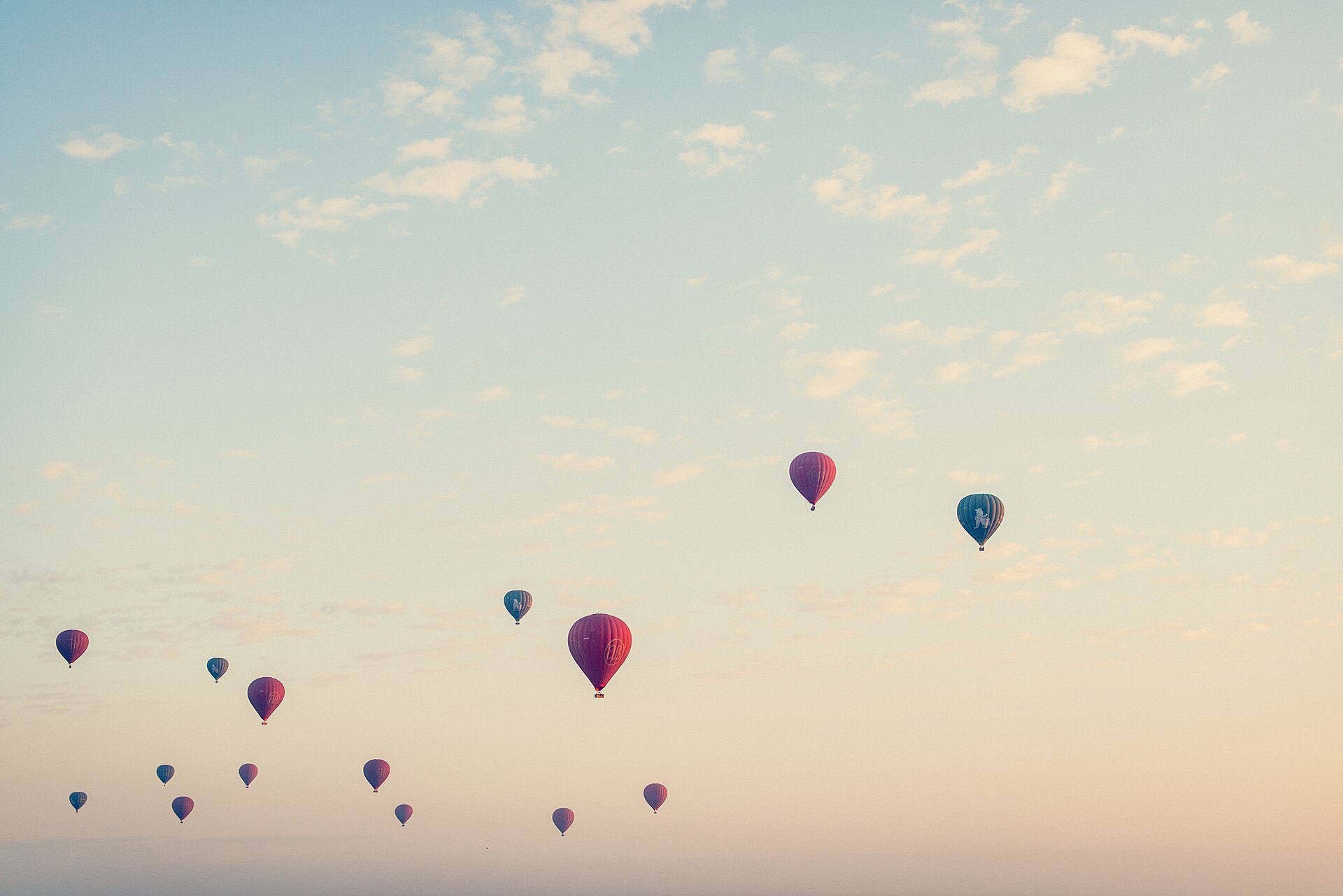

There are a handful of places on Earth where a balloon flight stops being a pleasant morning out and becomes something closer to a pilgrimage. Bagan, on a bend of the Irrawaddy River in central Myanmar, is one of them. Nothing quite prepares you for the moment the burner goes quiet and a plain of red-brick temples emerges from the mist below the basket, one spire after another. This is what the Bagan flight is about: a few silent minutes over the largest concentration of Buddhist monuments in the world, lit by the first sun of the day.
A plain of more than two thousand temples
Between the 11th and 13th centuries, the kings of Pagan (the old spelling of the name) ordered the construction of an estimated 10,000 religious buildings across roughly 100 square kilometres of dry plain. Earthquakes, floods and time have taken most of them, but more than 2,200 temples, stupas and monasteries still stand, and in 2019 the site was inscribed on the UNESCO World Heritage list. From the ground, the scale is hard to grasp because the trees and dust hide the horizon. From 300 metres up, it makes sudden sense: the temples form a loose grid that follows old roads and canals, with the biggest monuments, Ananda, Thatbyinnyu, Dhammayangyi and Shwezigon, rising like anchors in a sea of smaller shrines.
The colour is what we remember most. Bagan brick has a warm, oxidised orange, and at sunrise the low light rakes across the plain so that every terrace and finial throws a long shadow. The Irrawaddy, wide and pale, bounds the picture to the west, and on clear mornings the hills of Mount Popa show on the eastern edge.
The flying season, November to March
Balloons fly at Bagan only during the dry, cool season, which runs from roughly the beginning of November to the end of March. Outside this window the monsoon brings rain, low cloud and unstable air, and the summer heat from April onward makes the air too thin and gusty for safe passenger flights. Within the season, December and January are the sweet spot: the sky is usually clear, mornings are cool enough for a fleece, and the mist that gathers overnight in the low ground gives the classic layered look in photographs. February and March are hazier, which softens the light but shortens the views.
Because the season is short and demand is high, flights in peak weeks are often fully booked months ahead. Some mornings are cancelled for wind or visibility, so book for the first morning of your stay and keep a spare day in hand.
What the flight itself looks like
The day starts in the dark. Pick-ups leave the hotels of Nyaung U, Old Bagan and New Bagan between about 5:00 and 5:30, and a short drive brings you to the launch field, usually a patch of open ground on the northern or eastern edge of the archaeological zone. Tea and coffee appear while the crews inflate the envelopes, a spectacle in its own right.
Take-off is timed for the minutes before sunrise, around 6:15 to 6:45 depending on the month. The flight lasts 45 minutes to a little over an hour, and the pilot uses the light winds of the early morning, typically from the north-east in the cool season, to drift slowly south or south-west across the plain. Altitude varies from a few dozen metres, low enough to see the carved detail on a stupa terrace, to 500 or 600 metres for the wide panorama. The best pilots spend most of the flight low, because it is the intimacy with the temples that makes Bagan special. Landing is on farmland on the far side of the plain, followed by fruit and a glass of something fizzy before the drive back.
Prices, what to bring and how to get there
Bagan has always been one of the more expensive balloon destinations, partly because the season is so short. Expect roughly 350 to 450 US dollars per person for a standard shared flight, and more for smaller baskets or private charters. Payment is often requested in cash, in crisp new dollar notes, so ask when you book.
- A warm layer for the launch field: the plain is at about 60 metres above sea level, but December mornings can be close to 10 degrees C.
- Closed shoes, a hat and sunglasses for the drive back once the sun is up.
- A camera with a wide lens for the plain and a longer one for single temples.
- Your passport, which is checked at the launch site.
The nearest airport is Nyaung U, about 10 kilometres from Old Bagan, with domestic flights from Yangon in about 80 minutes and from Mandalay in around 30. The overland option is the road from Mandalay, about 180 kilometres and four to five hours, or a slow, lovely river boat down the Irrawaddy that takes most of a day. A small archaeological zone fee is payable on arrival and is separate from the balloon ticket.
A word on the current situation
We would not be doing our job if we did not mention that travel to Myanmar has been complicated since 2021. Several governments currently advise their citizens against all or non-essential travel to the country, and balloon operations at Bagan have been suspended for some seasons and run on a reduced scale in others. Whether and how the flights operate in any given winter depends on conditions that change from year to year. Before planning a trip, check your own government’s travel advice, confirm that flights are actually scheduled for your dates, and make sure your travel insurance is valid for the destination. None of this changes what Bagan is, a place of astonishing beauty and quiet, but it does mean the practical picture needs verifying close to the time.
Why it stays with you
Most balloon flights are about landscape. Bagan is about time. Every one of those temples was built by someone hoping for merit in a next life, and eight or nine centuries later they are still there, catching the same light. Floating over them in silence, we felt less like tourists than like witnesses. If the conditions allow you to go, go for the early season, book the first morning, and keep the camera down for at least a few minutes. Some views are better kept in memory than on a card.
